

Synopsis
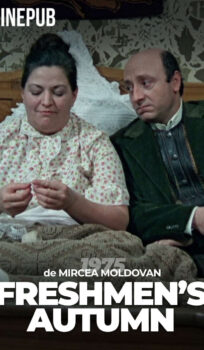
Foreword: The first film in the “Freshmen” series, starring Maria Ploae, Emil Hossu, and Dumitru Furdui as college graduates who, in keeping with the custom of the time, are assigned to the village of Viișoara, which they have no idea where to find on the map.

Directed by: Mircea Moldovan
Script: Petre Sălcudeanu
Cast: Marin Moraru, Draga Olteanu Matei, Emil Hossu, Sebastian Papaiani, Maria Ploae, Octavian Cotescu, Dumitru Furdui, Vasile Nițulescu, Monica Giuta, Elena Sereda, Nae Mazilu, Julieta Strâmbeanu, Ileana Jurciuc, Constantin Bîrliba, Haralambie Polizu, Tatiana Lili Iorga, Savu Rahoveanu, Vasile Ardeleanu, Elena Stescu
Producer: Beno Meirodici (Casa de Filme Unu)
Cinematography by: Ion Marinescu
Edited by: Adina Georgescu-Obrocea
Sound: Bogdan Capadia
Music: Paul Urmuzescu
Year: 1975
Category: Feature film
Genre: Comedy
Duration: 90 minutes
202,902 – Cinepub viewers
PLOT SUMMARY
After graduating from college, three graduates, French teacher Mariella Tudor (Maria Ploae), doctor Ovidiu Ghiculescu (Emil Hossu), and agricultural engineer Geo Severus (Dumitru Furdui), set off without knowing each other for the village of Viișoara, 599 km from Bucharest, where they had been assigned jobs.
CRITICAL REVIEWS:
“Young intellectuals (a doctor, a philologist, an agronomist) face, in a Transylvanian village, at their first job, the application of what they learned in the university laboratory. The ‘locomotive’ pulls two more ‘carriages’, corresponding to the seasons of the ‘newbies’, leading to the conclusion-message: ‘We didn’t come to leave, we came to stay, to improve agriculture and the village’. A comic illustration of socialist democracy in the countryside, although monotonous in its comic effects (the quarrels between Toderaș and Varvara, the changing moods of the young people hesitant in the face of difficulties, etc.), the film has the rare gift of rendering, in dialogue, the local color, an effort rarely practiced in our comedies.” – Tudor Caranfil
Călin Căliman considered that the film’s goal was not achieved and that “the comedy was difficult to follow.” (“History of Romanian Film 1897-2000”)
Cristian Tudor Popescu considered the series of films to be political and propagandistic in nature, specific to the communist era. The village depicted in the film is “a fictional universe, a parallel Romania”.
Dan Goanță noted the presence of elements of political propaganda such as collective leadership, harvest per hectare, and the proximity of the village to the city, with the representation of the village in the 1960s and 1970s being considered a “Ceausescu utopia”.
Although he also notes the propagandistic purpose, Ioan Lazăr nevertheless acknowledges the director’s merit in transforming the amorphous and dull material of a script into a comic fiction film, by reorganizing the material as a story recited by a commentator in an obviously ironic tone. Forced to compromise with censorship, the filmmakers turned the film into an “ideological farce,” in which the moral purpose was subverted by parodying the main characters. Lazăr noted the presence of “comically derailed examples” such as ineffective party meetings, where a member on maternity leave votes with colored flags, organizational errors in agricultural work caused by the indifference of those involved, etc. The falsification of engineer Geo’s identity provides an ingenious and subtle pretext for parodying collective property, even leading to the division of personal items. The film’s success with the public was determined by the tandem of Draga Olteanu Matei (Varvara) and Marin Moraru (Toderaș), by the mixture of urban and rural humor (present especially in the language), and by Mircea Moldovan’s directing style.
Eva Sârbu praised the charm of this film, which “lies in the freshness of its observation (…) in the tenderness of its point of view (…) in its tender understanding of the issues”. However, she stated that the filmmakers should not have joked about such topics.
“The theme of women’s emancipation in socialism, as exemplified by Lenuța, the tractor driver from the 1950s, is illustrated by the determined Varvara, who mobilizes her husband, who is resistant to change, leading the hostilities, as in Lysistrata, the cooperative version. The theme of birth rates also derives from the same woman, but moves on to honest girls from the countryside, such as Paulina, who want to get married and procreate in series, with Paulina announcing to her potential suitor that a medical examination has declared her fertile, an expression of reproductive sensuality placed somewhere between the udder and the moo”. – Adrian Ionescu, cinepub.ro
“Mircea Drăgan’s film is ultimately a comedy with a clear ideological score, without anything subversive, dramatizing a typical situation of life under communism with a resolution that is also in line with socialist ethics. The fact that this resolution is unrealistic and false is irrelevant: the mission of the director and screenwriter is to demonstrate the opposite and to create the premises for an awakening, as in the novels of collectivization, when in the end the well-intentioned peasant, but confused, understands how wonderful it is to give his land to the collective, where he will work hard for a pittance for the welfare of the entire people”. – Adrian Ionescu, cinepub.ro
TRIVIA:
- According to the commentator (Octavian Cotescu), Viișoara is a village that does not appear on tourist maps, which could be reached either by rail or by a stone-paved road dating back to Roman times.
- The title of the film comes from the proverb “Autumn is when the freshmen are counted”, referring to the start of a new school year. Screenwriter Petre Sălcudeanu had “a certain inclination towards the village world” (as stated by Draga Olteanu-Matei) and intended to make four films that would follow the integration of a group of college graduates into rural life throughout the four seasons of a year. Of these, only three were made, with Vara bobocilor remaining only in the planning stage. Sălcudeanu thought of forming a couple consisting of Draga Olteanu-Matei and Marin Moraru, to give the film a humorous side.
- The film entered production in April 1974 and was still in progress in November 1974, probably in the editing stage. It was made in the studios of the Bucharest Film Production Center.
- The animated opening credits were conceived and drawn by Florica Vintilă.
- The assistant director was Alexe Tudor.
- The final print was completed on May 9, 1975.
- The production costs amounted to 2,404,000 lei.
- Following Toamna bobocilor (Freshmen’s Autumn), screenwriter Petre Sălcudeanu and director Mircea Moldovan collaborated on two sequels: Iarna bobocilor (Freshmen’s Winter, 1977) and Primăvara bobocilor (Freshmen’s Spring, 1987), both less well received by audiences. In the latter, the couple Varvara and Toderașwere portrayed by Tamara Buciuceanu-Botez and Dem Rădulescu.
- The screenwriter also intended to write a script for a fourth installment, titled Vara bobocilor (Freshmen’s Spring), but it remained at the stage of intention.
- The film enjoyed great public success, being viewed by 3,511,851 spectators in Romanian cinemas, according to data compiled by the National Center of Cinematography, which recorded the number of viewers for Romanian films from their release date until December 31, 2007.
- At the end of the seventh decade of the 20th century, young university graduates were assigned to work in rural areas, being denied positions in major cities, following a decree issued by the country’s president. As a result, it became necessary to produce films that would instill in young graduates the idea that life in the countryside was beautiful and that professional fulfillment could be achieved there.
LINES:
• “If all the trains leaving Viișoara go to Bucharest, not all the trains leaving Bucharest go to Viișoara.” — Narrator (Octavian Cotescu)
• “Here we are in Viișoara!” — Toderaș (Marin Moraru)
• “She asked to come here. Don’t be foolish — a woman like that doesn’t need your man.” — Varvara (Draga Olteanu Matei)
• “A woman, if she wants to win her man, must fight for him!” — Varvara (Draga Olteanu Matei)
• “Only creatures without speech stay silent and obey!” — Varvara (Draga Olteanu Matei)
• “I finished high school, comrade. And three years of technical school. I’m a technician! So please, speak to me with respect.” — Pompei (Sebastian Papaiani)
• “I have to finish my three-year assignment.” — Ovidiu (Emil Hossu)
• “Gentlemen are gentlemen, even without a title!” — Toderaș (Marin Moraru)
• “I’m for peace!” — Toderaș (Marin Moraru)
• “A declaration of war should be answered with another declaration of war.” — Narrator (Octavian Cotescu)
• “The human soul is so changeable.” — Narrator (Octavian Cotescu)
• “Țuica (Romanian plum brandy) makes the mind clear!” — Varvara (Draga Olteanu Matei)
• “These ones — they come and go, come and go. Just like that.” — Toderaș (Marin Moraru)
ARTICLES:
- Great Film, Indeed — “Freshmen’s Winter”, on TVR1 — tvr.ro
- The Autumn of the Freshmen — tvr.ro
- Romanian Theatre and Film. The “Freshmen” Series (1975, 1977, 1985) — agerpres.ro
This premiere is part of a national archive project supported by the Romanian National Film Centre.
Special thanks goes to the Romanian Filmmakers Union and to the Romanian Film Archive.


