
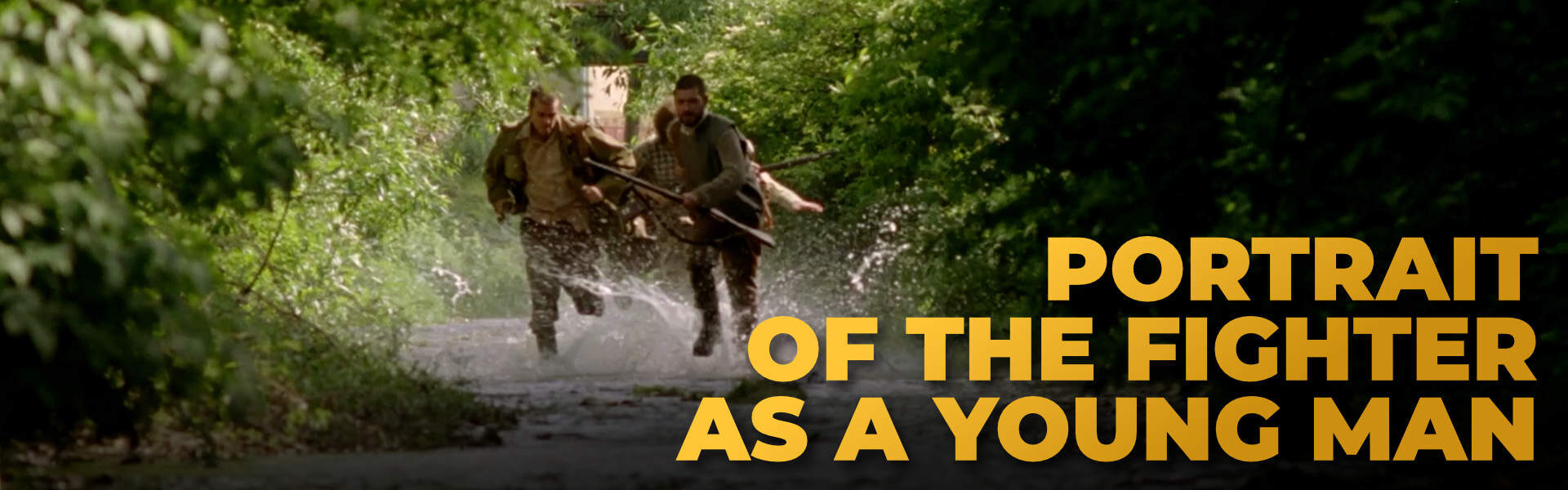

PORTRAIT OF THE FIGHTER AS A YOUNG MAN (2010) – history film online
- November 18, 2010
Synopsis
Foreword: The story of Ion Gavrilă Ogoranu’s anti-communist resistance group, which operated in the Făgăraș Mountains in the period following the establishment of the communist dictatorship in Romania.
“One of the few Romanian films that comes closest to defining who we are, but does so not by chronicling daily life, but by showing who we were.” — Lucian Georgescu (cinepub.ro)

Directed by: Constantin Popescu Jr.
Script by: Constantin Popescu Jr.
Cast: Constantin Diță, Cătălin Babliuc, Ionuț Carac, Vasile Calofir, Bogdan Dumitrache, Dan Bordeianu, Constantin Lupescu, Cosmin Natanticu, Bogdan Cotleț, Alexandru Pavel, Adrian Nicolae, Paul Ipate, Andrei Mateiu, Alexandru Potocean, Ion Bechet, Radu Iacoban, Alin Mihalache, Ștefan Gomoi, Claudiu Maier, Aura Călărașu, Mircea Drâmbăreanu, Cătălin Naum, Raluca Rusu, Andrei Ralea, Ion Cosma, Cosmin Mircea Crețu, Florin Lăzărescu, Dorian Boguță, Mihai Constantin, Mihai Bendeac, Cosmin Seleși, Emanuel Pârvu, Bogdan Stanoevici, Gabriel Bucur, Sergiu Fleșner, Dan Rădulescu, Răzvan Vasilescu, Mimi Brănescu, Nicodim Ungureanu
Producer: Constantin (Titi) Popescu
Cinematography by: Liviu Mărghidan
Edited by: Corina Stavilă
Sound: Mihai Bogos
Year: 2010
Category: Feature film
Genre: Drama, History
Duration: 161 minutes
PLOT SUMMARY
In 1947, anti-communist partisan groups were retreating into the mountains. Enemies of the regime, hunted by the authorities yet beloved by ordinary Romanians, the partisans faced a remarkable fate. The events in Constantin Popescu’s film are inspired by reality, with the action unfolding over the course of an entire decade.
AWARDS
- 2010 – Bratislava International Film Festival (Slovakia) – Best Director Award
- 2010 – B-EST – Audience Award and Best Cinematography Award
- 2011 – Gopo – Best Supporting Actor Award (Bogdan Dumitrache)
- 2011 – Gopo – Best Cinematography Award
FESTIVALS
- 2010 – Berlin International Film Festival (Berlinale)
- 2011 – B-EST International Film Festival
- 2010 – Transylvania International Film Festival (TIFF)
- 2010: Bratislava International Film Festival (Slovakia)
- 2010 – London International Film Festival
- 2010 – Turin International Film Festival
DIRECTOR’S STATEMENT
“I decided to direct three films about the struggle against communism in my country after studying archival materials and documents from the period 1945 – 1965. That is how I learned that there had been a resistance movement against the regime. I knew to some extent — as every Romanian does — what was happening in Europe and around the world regarding communism. I learned about the imprisonment of those who opposed the regime, about the methods used by the Romanian secret police in an attempt to silence the voices criticizing the regime, the horrors and lies of the dictatorship (…) But I also discovered that there were many things I knew nothing about regarding that side of my country’s history. Things I hadn’t learned in school. I learned about the existence of more than 1,000 partisan groups that opposed the communist movement in Romania for over 10 years; I learned stories of women and men who died believing in their ideals, who refused to compromise. A long-lasting resistance movement, which turns out to have been among the longest in the history of Eastern European states, if not the longest.” – Constantin Popescu Jr., stiridebine.ro
CRITICAL REVIEWS:
“The title the director has given the film — a graduate of Letters — is a direct allusion to ‘A Portrait of the Artist as a Young Man’. Where James Joyce places the formation of artistic consciousness and individual identity at the centre of the modern Bildungsroman, Popescu replaces the artist with the fighter; in the Romanian context of the 1950s, the only available form of self-affirmation against the oppressive system was not creation but armed resistance. The artist defines himself through his work, Popescu’s heroes define themselves through struggle — and all of them, in Joyce as in Popescu, do so at the cost of exclusion from the society that surrounds them. But if (Stephen) Dedalus (!) flees Ireland to find his creative freedom, Popescu’s fighters cannot flee anywhere, and it is precisely this impossibility of flight that becomes the condition of their identity. Icarus becomes Sisyphus.” – Lucian Georgescu, cinepub.ro
“A very long film that relies on the power of monotony to evoke moods and cinematic expressiveness; I couldn’t help but compare it to Steven Soderbergh’s ‘Che’ (2009), another mammoth film.” – Angelo Mitchievici, România literară, no. 47 / 2010, aarc.ro
“It is the first Romanian film in the last ten years to handle drama correctly, in a commercial spirit. It has tension, it has drama, it has violence — a lot of violence — presented appropriately; it is a thriller that by no means wastes the money spent on a ticket. From a cinematic standpoint, as a drama, ‘Portrait…’ is the equivalent of ‘Philanthropy’ (the comedy directed by Nae Caranfil). Both work honestly with the possibilities of cinema, both have more pros than cons, and both have a high potential to please audiences.” – Lucian Maier, agenda.liternet.ro
“The communists are mocked, crudely and repetitively, through parallel montages in which their bosses speak, from their offices, about the use of intelligence, sweet talk, etc., while on the ground they operate with kicks to the gut. Răzvan Vasilescu has two interminable scenes in which, playing a secret police officer, he curses a priest and sets a woman on fire.” – Andrei Gorzo, agenda.liternet.ro
“This isn’t Czechoslovakia, Poland, or Hungary, let alone Norway or France under German occupation. Here, people die anonymously for the sake of the people, and worse still, the bill is compounded by a second, posthumous death — one that stems from the lives of the torturers, who live happily ever after into their old age. The film has the merit of chilling you to the bone because it captures precisely this — or perhaps only this — the perpetual, repetitive condemnation of people out of step with the rest. A feeling as heavy as a tombstone.” – Radu Naum, agenda.liternet.ro
“It’s not a historical film. It’s a film about us, the people of today, who still pretend we had no choice. That we have no choice. All the philosophy, ideologies, and nuances of the world, including patriotism, ultimately boil down to simple things, to simple gestures.” – Maria Andrieș, agenda.liternet.ro
“I don’t think the filmmakers set out to make a historical film. (…) The Portrait of the Fighter as a Young Man is the dramatic chronicle of a ‘game with death’ fully embraced by minds not yet corrupted by egalitarian utopia.” – Marian Rădulescu, agenda.liternet.ro
“Someone watching the film might wonder what drove Ion Gavrilă Ogoranu and his comrades to fight against the communist state — a struggle disproportionate in its means, whose final outcome was easily foreseeable. Yet, from the perspective of time, it remains one of the few testimonies to a nation’s courage. And I would say that the same spiritual impulses that drove Constantin Popescu’s heroes to climb the mountains and fight with weapons in hand also led today’s young director to make this film. The same sorrow, the same fervor, the same truth.” – Vasile Silion, agenda.liternet.ro
“If his primary goal was to make a film that captures a historical moment, it’s understandable why he also wanted to show us how Secret Police meetings were conducted, what their ideology was, and how they operated in the field.” – Iulia Blaga, Hotnews.ro, November 2010, aarc.ro
“It is a large-scale production not only because of the impressive number of actors and extras, but also due to its cinematic structure, akin to a chronicle of events — a concept involving a succession of incidents from immediate reality, from the harsh daily life of a constant flight, in contrast to the ideological meetings and the harassment of the families and loved ones of those in the mountains.” – Ileana Bîrsan, Observator cultural, December 2010, aarc.ro
TRIVIA:
- The film marks the feature film debut of director Constantin Popescu Jr.
- Before directing his debut film, Constantin Popescu Jr. served as an assistant director and production assistant on four of Lucian Pintilie’s films and as second unit director for Francis Ford Coppola on “Youth Without Youth.”
- Constantin Popescu Jr. is also one of the directors of the omnibus film “Memories from the Golden Age.”
- The portrait of the fighter in his youth was intended to be the first part of the trilogy “Almost Silence”, which director Constantin Popescu planned to make. The other two films in the trilogy were to focus on Elisabeta Rizea and the brothers Petre and Toma Arnăuțoiu from Muscel, respectively. The film Elisabeta Rizea was made in 2013 by Mihai Constantinescu.
- The approximate budget allocated to the film was around 800,000 euros.
- The film is based on a true story: Immediately after World War II, when the communists seized power, groups of people in the mountains of Romania took up arms to oppose the oppressive regime. Almost all of them ended up in prison or facing a firing squad. More than 1,000 groups of anti-communist “partisans” were recorded in the Securitate files, with the Făgăraș Mountains serving as one of the centers of this struggle between 1947 and 1960. One of the longest-lasting groups was the one led by Ion Gavrilă Ogoranu: the 12 young men held out in the Făgăraș Mountains, under extremely difficult conditions, for nearly ten years. Ogoranu was the only member of the group who was not captured until 1976, a unique occurrence in the history of partisan groups anywhere.
- For his research, the director drew upon memoirs and the Secret Police archives.
- The film is produced by Filmex Film Romania, with support from the National Center for Cinematography and HBO Romania.
• The film is distributed in Romania by Voodoo Films.
LINES:
• “How many things are different from what science says!” – Ion Chiujdea “The Professor” – Cătălin Babliuc
• “Here at the Secret Police, what is our tool? If the barber has a razor, if the turner has a lathe, (…) our tool is our informants!” – Lieutenant General Gheorghe Pintilie Bodnarenko (Mihai Constantin)
• “We have plenty to learn from. We don’t have to look for something unknown; the Bolshevik Party has done almost all the work — they’re feeding it to us on a silver platter.” – Lieutenant General Gheorghe Pintilie Bodnarenko (Mihai Constantin)
• “First the cow, then the wife?” – Victor Metea (Dan Bordeianu)
• “Comrades who believe in God have no place here!” – Lieutenant General Gheorghe Pintilie Bodnarenko (Mihai Constantin)
• “Where is that God of yours? Why doesn’t he strike me down right now?” – Major Alimănescu (Răzvan Vasilescu)
• “Who’s coming to save you? Your God or the Americans?” – Major Alimănescu (Răzvan Vasilescu)
• “No more fingernails? (…) Never mind, there’s still more to pull out. Let’s move on to the teeth.” – Major Alimănescu (Răzvan Vasilescu)
• “There is still a corner of the Kingdom of Romania that has not bowed its head to the communists.” – Ion Gavrilă Ogoranu “Moșu” (Constantin Diță)
• “One day, all of Romania will be free.” – Ion Gavrilă Ogoranu “Moșu” (Constantin Diță)
• I want to be able to look my child in the eyes! – Ion Gavrilă Ogoranu “Moșu” (Constantin Diță)
ARTICLES:
- Portrait of the Fighter as a Young Man – aarc.ro
- Film about the anti-communist resistance hits the screens – adevarul.ro
- “Portrait of the Fighter as a Young Man” wins Best Director award in Bratislava – adevarul.ro
- Review: “Partisans”, by Andrei Gorzo – agenda.liternet.ro
- Review: “Portrait of the Fighter as a Young Man”, by Lucian Maier – agenda.liternet.ro
- Review: “Anti-film about Anti-Romania”, by Radu Naum – agenda.liternet.ro
- Review: “Freedom Is Cruel”, by Maria Andrieș – agenda.liternet.ro
- Review: “Thoughts on a Certain Moment in Film”, by Marian Rădulescu, agenda.liternet.ro
- Review: “The Director’s Courage in Youth,” by Vasile Silion, agenda.liternet.ro
- Review: “In Search of Peace”, by Iulia Blaga – aarc.ro
- Review: “The Path of Maximum Resistance”, by Ileana Bîrsan – aarc.ro
- Review: “Picnic by the Roadside”, by Angelo Mitchievici – aarc.ro
This premiere is part of a national archive project supported by the Romanian National Film Centre.
Special thanks goes to the Romanian Filmmakers Union and to the Romanian Film Archive.


