
Synopsis
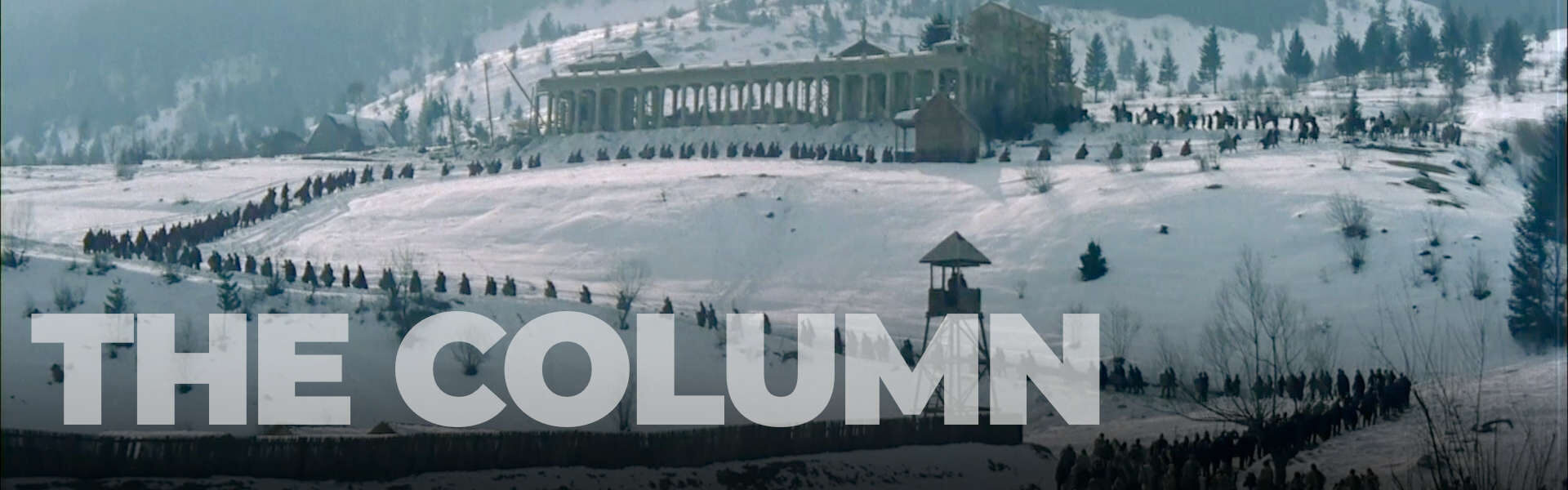
Foreword: The Column (1968) is a historical blockbuster: the cornerstone piece of the national cinematic epic, with action set during and after the second Dacian-Roman war (106–114), in the territory where new relationships begin to crystallize between victors and vanquished, between the winners of battles and the surviving native population, between those who seek to avenge past defeats and those who pursue reconciliation in order to halt the barbarian invasions. – Bujor T. Râpeanu (Filmed in Romania, 2004, Pro Foundation Publishing)
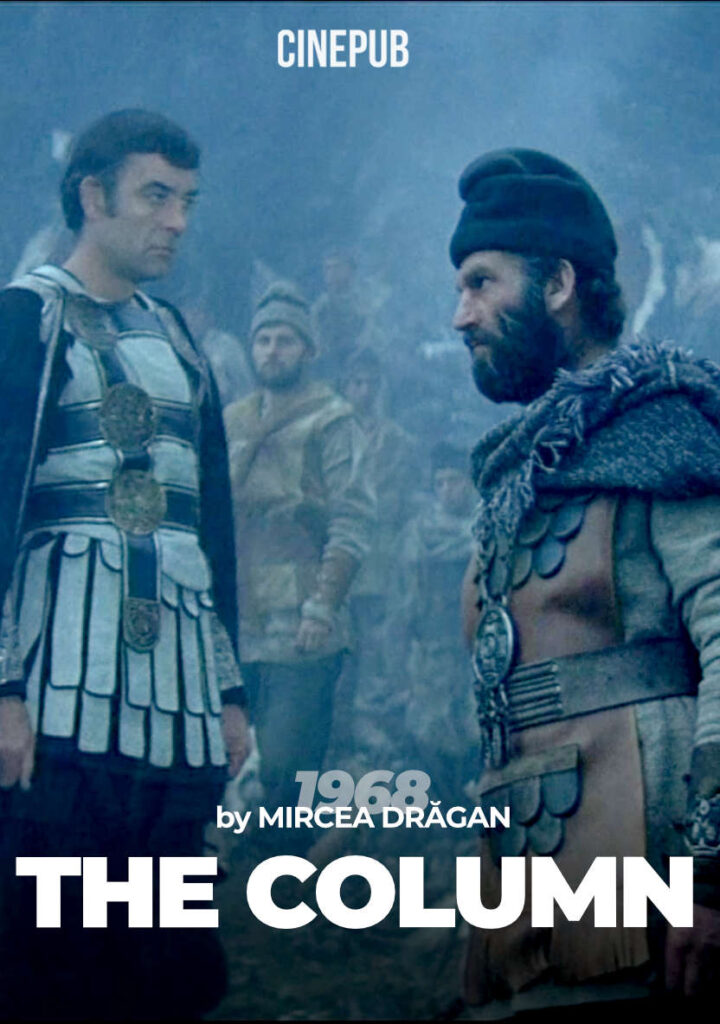
Directed by: Mircea Drăgan
Script: Titus Popovici
Cast: Richard Johnson, Antonella Lualdi, Ilarion Ciobanu, Ștefan Ciubotărașu, Amedeo Nazzari, Amza Pellea, Emil Botta, Franco Interlenghi, Gheorghe Dinică, Florin Piersic, Sidonia Manolache, Maria Cupcea, Ovidiu Iuliu Moldovan, Alexandrina Pascu, Ina Otilia Ghiulea, Nicolae Sireteanu, Nicolae Radu
Producer: Artur Brauner
Cinematography by: Nicu Stan
Edited by: Dragoș Witkowski
Sound: Anușavam Salamanian
Music: Theodor Grigoriu
Year: 1968
Category: Feature film
Genre: History, Drama
Duration: 135 minutes
143,082 – Cinepub viewers
PLOT SUMMARY
The years 106–114: Emperor Trajan lays siege to Sarmizegetusa. Once inside the conquered fortress, the Romans find no one left alive. Betrayed by Bastus, Decebalus, the Dacian king, commits suicide. Trajan devises a vast plan for the colonization of Dacia.
AWARDS
- 1969 – Adelaide International Film Festival, Australia – Certificate of Merit
CRITICAL REVIEWS:
“Inspired by ‘the first film carved in stone about the conquest of Dacia,’ Titus Popovici’s screenplay focuses on the construction of a Roman municipium, on the reconciliation between victors and vanquished, and on the suggestion of a people’s genesis. A dramatic material far beyond the director’s capabilities was scattered in a blind melee. Paradoxically, as in The Șoimărești Clan, the pace drags precisely in the confused battle scenes.” – Tudor Caranfil
“The two historical figures who appear only at the beginning of the film set the tone, their actions marking the evolution of the relationship between the two peoples. Decebalus is portrayed as a primus inter pares, a reflection of the early period of the Ceaușescu regime, when the cult of personality had not yet begun—one that, in cinema, would later impose authoritarian leader characters whose orders were not to be questioned.” – Bogdan Jitea, iiccmer.ro
“Monumental, in the Romanian sense, is above all a certain internalized feeling of time, of nature, of the cosmos. This is also the suggestion contained in some of the best sequences of The Column. The death of Decebalus is placed by Titus Popovici and Mircea Drăgan on a mountain peak. From there, in his final moment, the hero has a cosmic vision of his land, conveyed succinctly through a calm, even panoramic shot — an intense gaze that, from the height of the hero’s deeds and strength, scans the future of this land through the red veil of blood that is time. On the horizon lies the glimmer of a setting sun, although, in an image less illustrative yet akin to those sublime, inverted metaphors of Romanian folklore (“At my wedding / A star fell”), the sun could just as well have been rising. A solemn metronome seems to measure, in the film’s musical score, the moments of this pivotal scene, and here the director truly reveals a vocation for dense and vibrant gravity. A rare consonance of suggestion and rhythm ties together the slow, mythic ritual gestures with which Decebalus offers himself to death, and Tiberius severs his head; the heavy gazes Gerula casts, as if from great distances, toward the Roman; the circular movements of the camera, like those of a shaken witness.” – Valerian Sava, Cinema Magazine, no. 11, November 1968
“Through the distinctions it introduces within its own structure, the ending of The Column is yet another argument for a higher calling of our historical cinema.” – Valerian Sava, Cinema Magazine, no. 11, November 1968
“The creators of the film The Column have chosen, from the history of our people, the most difficult episode: that of genesis. How was proud independence converted into equally proud Roman consciousness? How did the stern Roman soldier transform into a constructive citizen of the province of Dacia? How did the relentless enemies of yesterday come to understand one another—how did they, together, raise marble temples upon the smoldering ruins of Zamolxis’s sanctuaries? By what miracle did hatred turn into love and the sword into a plow? What law of history laid the strategic foundations of the Roman limes in the Carpathians, the hearth of the Romanian people?” – Virgil Cândea, Cinema Magazine, no. 11, November 1968
“The Column was conceived in human terms—first as a living historical drama, and only afterward as a monument. Since it’s not about national heroes (Decebal does something noble and dies in the first 10 minutes), the screenwriter, Titus Popovici, was able to portray his characters on a normal scale.” – Andrei Gorzo, agenda.liternet.ro
“Another pleasure here is seeing Romanian cinema aligned with the 1960s practice of international casting. And so what if Richard Johnson was a Richard for those who couldn’t afford Burton, and Antonella Lualdi had no reason to cause Sophia Loren any professional anxiety? What matters is that he is good, and she’s not bad either. Gheorghe Dinică is superb in the role of the traitor Bastos, and his mea culpa (“In my wretchedness, like a rabid dog…”) rightfully became part of folklore.” – Andrei Gorzo, agenda.liternet.ro
“The mythical dimension of the plot is well highlighted in sequences such as the trial of the ‘lords,’ in which even Zamolxis himself could have taken part. The scene where Decebal bids farewell to the land of his country is memorable, as is the one seen through Tiberius’s subjective, alcohol-blurred perspective, as he parties with ‘Ciungu’ (the moment with the two revelers is the most humorous, and the improbable buddy movie element significantly increases the film’s appeal).” – Mihai Fulger, cinepub.ro
TRIVIA:
- The film is a Romanian-German co-production.
- After the script was reviewed by the Artistic Council, the film entered the production phase on January 9, 1967. The following consultants were involved in the making of the film: historical consultant – Prof. Dr. Hadrian Daicoviciu (a renowned Dacologist, son of Constantin Daicoviciu), military consultant – Lt. Col. Gheorghe Romanescu, combat consultant – Angelus Pellegrini, horseback riding consultants – Ion Apahideanu and Florea Pădureanu, and dance consultant – Petre Bodeuț.
- Filming took place between October 7, 1967, and January 31, 1968, and then again from March to May 1968. Locations included Râșnov, Zărnești, Stâna de Vale, the Bicaz Gorges, and the Bucegi Plateau.
- The production costs (on the Romanian side) amounted to 19,395,369 lei.
- The film depicts the beginnings of the Romanization of Dacia, drawing from sources such as Dio Cassius’s Roman History, Jordanes’s Getica, Criton’s Getica, Juvenal’s Satires, as well as the bas-reliefs on the triumphal monument Tropaeum Traiani at Adamclisi and on Trajan’s The Column in the Roman Forum. Historians believe that two-thirds of the film’s nature is diegetic (fictional universe), with artistic expression carrying more weight than factual information. A large part of the film includes imagined scenes.
- The Column continues the storyline from The Dacians, with the screenwriter carrying over some characters from the film directed by Sergiu Nicolaescu, namely: Decebal (played by Amza Pellea) and the Dacian High Priest (played by Emil Botta).
- It was Romania’s submission for the Best Foreign Language Film Oscar in 1969, but it was not nominated in the competition.
- The voices of the foreign actors were dubbed by Romanian actors: Mircea Albulescu dubbed Richard Johnson, Valeria Gagialov dubbed Antonella Lualdi, Geo Barton dubbed Amedeo Nazzari, and Gheorghe Cozorici dubbed Franco Interlenghi.
- In an interview for Cinema Magazine on November 11, 1968, Richard Johnson, the actor who played Tiberius, said about his role: Tiberius is one of the roles I liked very much. I felt a strong connection to this hero and tried to express as sensitively as possible this sympathy, this identification of mine with the character. I was moved now, seeing Tiberius again on screen and realizing that I succeeded in bringing him to life as I found him in Titus Popovici’s script and as I tried to complete him with my own imagination. Tiberius is a historical character, but at the same time modern through the traits that characterize his great personality.
LINES:
• “In my wickedness, like a rabid dog with tears in my eyes, I bit the hand that raised me and fed me, and I watched with a smile as my people died of thirst on the walls” – Bastus (Gheorghe Dinica)
• “What are you looking for in our mountains?” – Gerula (Ilarion Ciobanu)
• “I am a capable man. Many women have wanted to unite their names with mine.” – Tiberius (Richard Johnson)
• “Do you know what oranges are? I do.” – Tiberius (Richard Johnson)
• “Don’t touch me, Roman. I hate you. I hate you like I hate all of you.” – Andrada (Antonella Lualdi)
• “We’ll all build houses as big as Tiberius’s. (…) Water pipes everywhere!” – Dac
• “One day I’ll catch him and kill him!” – Tiberius (Richard Johnson)
• “We have obeyed only one law: never to bow our knees to anyone! Not even Sarmisegetuza, which was never lost. But we, but they, but they, but I, are we dead? As long as I can move, as long as there is a single Dacian who wants to live free, we will fight for this good and beautiful land. If we no longer have cities, we will fight for their ruins. And when there is only a single palm of land left on which we can stand, we will fight for that palm. This is the law, the only law! I know no other! The last right we have is to give our lives.” – Decebal (Amza Pellea)
• “I conquered Dacia so that there would be peace. And there will be peace, Roman peace, with them. Yes, together with them. […] I defeated Decebal, but not the Dacians. Now we must conquer them.” – Trajan (Amedeo Nazzari)
• “Accept this man who worships you for eternity. Accept the man who knows how to love always with faith. Ovid, amores. This man is me, who loves you.” – Tiberius (Richard Johnson)
• “My dear, we must live here on this land, endure. We belong to this land, which is ours.” – Gerula (Ilarion Ciobanu)
• “By that I recognize you, my son, citizen of Rome and Dacia, free man and master!” – Tiberius (Richard Johnson)
• “Understand me: I don’t want to and I can’t, even if I wanted to! He named my child Traianus, he wants to raise him under Roman law, he forces me to wear Roman clothes. He wants me to go to Rome with him!” – Andrada (Antonella Lualdi)
• “You who brought them into our homes, into our forum, look at them! Do you love them? Can’t you see? We eat like them, we live like them, we dress like them. Did we defeat them, or did they defeat us?” – Roman soldier
• “I believe you are the leader. So I will speak to you. For years I have felt you everywhere, like a poisonous shadow. You are killing my people. You have desecrated their bodies. Dac, the gods have spoken, and the gods have given us victory.” – Tiberius (Richard Johnsons)
• “You raised these young men like savages, but did you teach them to build roads and houses? Did you teach them to enjoy life? To raise their children in peace? No! You taught them only to kill.” – Tiberius (Richard Johnsons)
• “Now we are here. Either we live together, or we destroy each other. Or others come to destroy us.” – Tiberius (Richard Johnsons)
ARTICLES:
- “I wait with excitement” – aarc.ro
- The Column… and Dacia Felix – aarc.ro
- Hate in love. The sword in the plow – aarc.ro
- Memories are made of this too – agenda.liternet.ro
- The Column – iiccmer.ro
- The Column (1968) – istoriafilmuluiromanesc.ro
This premiere is part of a national archive project supported by the Romanian National Film Centre.
Special thanks goes to the Romanian Filmmakers Union and to the Romanian Film Archive.


