
Synopsis
Foreword:“Who Is Right” remains Alexandru Tatos’s final film, completed and presented to the public by his team — led by cinematographer Vivi Drăgan Vasile — following the director’s passing.
Directed by: Alexandru Tatos
Script by: Paul Everac
Cast: Andrei Ralea, Oana Pellea, Andrei Finți, Zoltan Vadasz, Maria Munteanu, Ovidiu Ghiniță, Valeriu Preda, Emilian Belcin, Cătălina Mustață, Liviu Pancu, Cerasela Iosifescu, Marin Alexandrescu, Smaragda Olteanu, Constantin Rășchitor
Producer: Cristina Corciovescu
Cinematography by: Vivi Drăgan Vasile
Edited by: Adina Petrescu
Sound: Horea Murgu, Mihai Popescu
Music: Anca Dumitrescu
Year: 1990
Category: Feature film
Genre: Drama
Duration: 79 minutes
PLOT SUMMARY
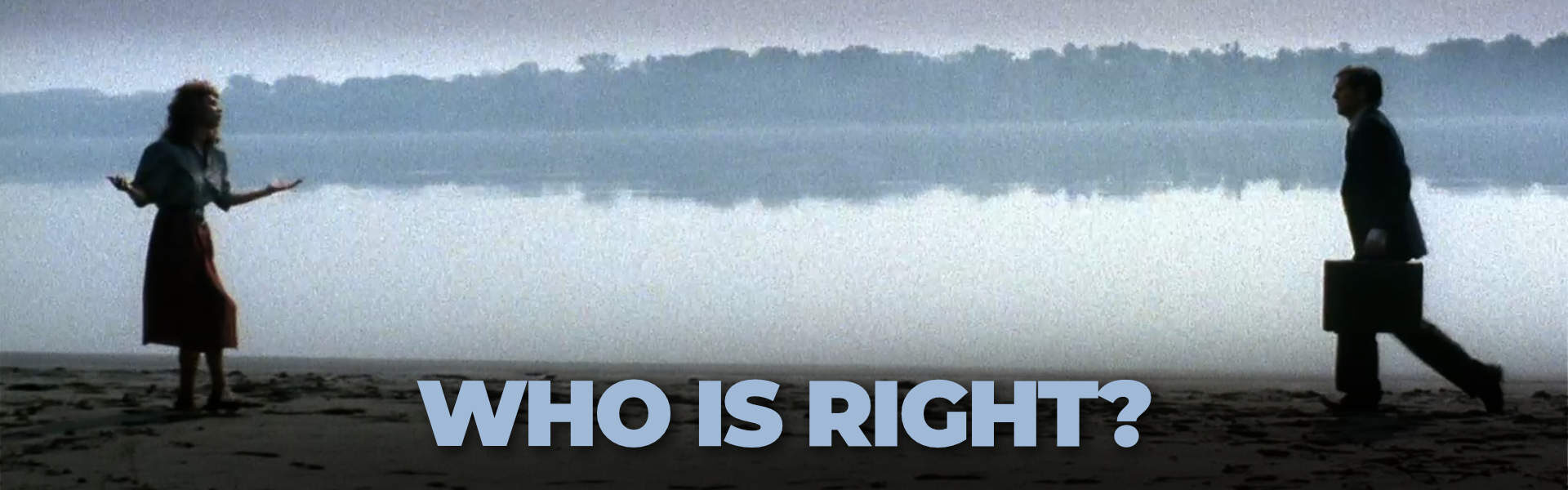
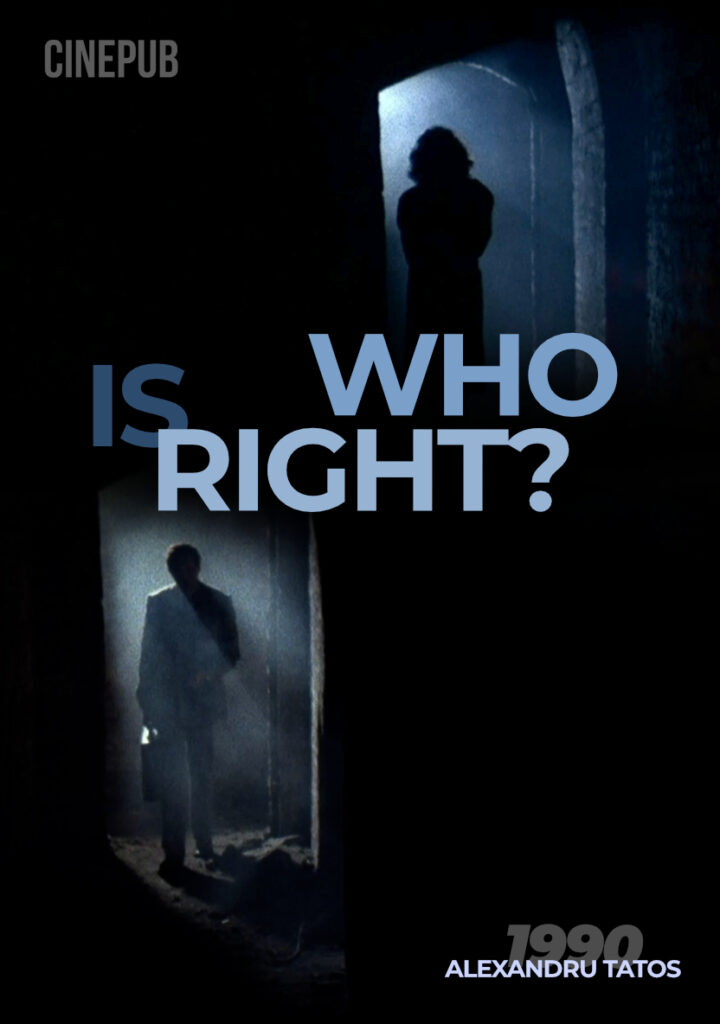
The accident that occurred at a large industrial complex on the banks of the Danube requires a thorough investigation by the relevant ministry. Alexandru Nedelcu, the inspector assigned to this investigation, must untangle the complicated web of lies, resentments, and jealousies, and ultimately concludes that the accused — engineer Radu Zimniceanu, his former classmate, and engineer Lidia Dumitru — are not guilty. However, Nedelcu’s integrity is in turn called into question by those with a vested interest in preventing the truth from coming to light — and who have the power to influence the Ministry to launch a new investigation.
DIRECTOR’S STATEMENT
Alexandru Tatos, for the magazine “Cinema”, February 1982
“The secret of art and the artist is to succeed in surprising the viewer, to imbue an apparently mundane event with the potential and broader meanings it implies.”
“An artistic career is like a marathon that ends with the end of the artist’s life.”
“Professionalism isn’t everything in a film. If the film lacks that distinctive touch of its own, if the characters and the story don’t break the mold and become unmistakable (yet at the same time universally human), it’s all for naught. Professionalism is a must: like brushing your teeth.”
“In each of my films I have used cinéma vérité. Often, classical mise-en-scène is confused with this live capture of reality. Even in reviews of my own films, this confusion has arisen. Which means that sometimes ‘artifice’ or ‘convention’ can be just as ‘real’ as cinéma vérité. I’m not saying anything new when I assert that in cinema, reality can often be truer when you create it…”
CRITICAL REVIEWS:
“Filmed during the final months of Ceaușescu’s regime, ‘Who Is Right?’ had the rare opportunity to be completed amid the atmosphere of unbridled freedom following the fall of communism and to avoid the numerous screening sessions that often led to substantial changes that altered the director’s intentions and vision. The unique context in which it was made offers us a rare opportunity to glimpse, in a counterfactual sense, what Ceaușescu-era cinema might have looked like in the absence of the restrictive censorship system. Alexandru Tatos’s final film is ultimately a curious cultural artifact, both a witness to and a product of the two worlds irrevocably divided by the traumatic events of December 1989.” – Bogdan Jitea, cinepub.ro
“In the film’s plot, in the characters’ dilemmas, but especially in the web of deception that leads to the film’s (truly vicious) vicious-circle conclusion, the director has found a fertile ground for expressing his own state of mind. Thus, the film about an ‘accident’ in an industrial plant (featuring the traditional representative ‘from the center’ who comes to investigate the circumstances of the accident) explicitly becomes a film about a far more serious social breakdown — the moral, economic, and spiritual breakdown of a society based on lies, denunciation, and opportunism.” – Călin Căliman, “Noul Cinema” magazine, no. 7/1990, aarc.ro
“The film stands as a testament not only to the distortion of art under control but, even more strikingly, to the artist’s unyielding resistance.” – Tudor Caranfil, “Dictionary of Romanian Films”, 2002
“The film raises the question of whether it is possible to reach objective truth, which remains unknown to those ‘on the outside’ due to suspicion. It is a world in which, in order to remain human, you must withdraw, hide.” – Marian Rădulescu, agenda.liternet.ro
“Here we have everything you (don’t) want: the ‘progressive’ engineer, the reactionary and opportunistic engineer, a young man who ran away from home… to live in the dormitory for single people and attend night school, the workers’ cafeteria (admittedly, less attractive and varied than similar food courts in today’s malls, but just as impersonal as those), a principled (i.e., asexual) love story, and so on; in other words, the customs and clichés of the era are found here in abundance. But Alexandru Tatos knows how to overcome these shortcomings and deliver, once again, a genuine, pure, honest film.” – Ioan-Pavel Azap, istoriafilmului.ro
“Alexandru Tatos built his body of work with care, precision, and the mastery of a jeweler. His voice was not a shout; it was a whisper — a whisper that held within it the stifled cry of rebellion, of anger, of accusation. He never tolerated mystification. He believed that everything that is sordid, degrading, and demagogic must disappear. He thought with the depth and nobility of a romantic hero… Then came the films… The ten films we still watch today with the joy of being drawn into them, into a human substance where dialogue and communion reinforce the uprightness of being.” – Alexa Visarion, in the preface to the volume “Theater, First Love”
“Tatos is not only a director, he is also an intellectual.” – Eugenia Vodă
TRIVIA:
- Filming was completed on November 9, 1989, but Alexandru Tatos passed away on January 31, 1990, which is why the film was finished by his former crew members (under the direction of cinematographer Vivi Drăgan Vasile).
- It premiered on June 4, 1990. On Friday, June 1, 1990, at 10:00 a.m., a preview screening of the film took place at the Film Distribution Directorate (Iulius Fucik Street), during which the film’s production team met with members of the (specialized) press. The participants spoke of the director’s exemplary dedication to his work. Among those present were Radu Stegăroiu, Paul Everac, Vivi Drăgan, Cristina Corciovescu, and Liana Tatos. (Ion Crețu, “Requiem for Alexandru Tatos”).
- The film was viewed by 53,879 viewers in Romanian cinemas, as attested by a report on the number of viewers for Romanian films from the premiere date through December 31, 2014, compiled by the National Center for Cinematography.
- Alexandru Tatos, born on March 9, 1937, in Bucharest, belongs, chronologically speaking, to the most prolific group in the history of Romanian cinema to date, the “1970s generation”.
- Trained as a theater director and a graduate of the relevant department at the Institute of Theater and Cinematographic Arts in Bucharest, like other great Romanian directors (Jean Georgescu, Victor Iliu, Liviu Ciulei, Lucian Pintilie), Tatos moved to film and television, with his first experience behind the camera coming with the series “August in Flames” (1974), produced together with Dan Piţa.
- His film “Sequences” ranks fifth on the list of the 10 best Romanian films of all time, compiled in 2008 by 40 film critics.
- “Red Apples” is his first feature film for the big screen.
- The bust of Tatos, sculpted by Grigore Minea, has stood since 2003 in the square on Toamnei Street, near Salcâmilor Street, where the director lived his entire life.
LINES:
• “Certain comrades, out of sympathy or for some other reason, tolerate people at work who aren’t up to par.” – Cernăucan (Smaragda Olteanu)
• “Why is she so damn moody? Is she having problems? Isn’t she married?” – Eng. Alexandru Nedelcu (Andrei Ralea)
• “People say she’s seeing a foreigner. A West German or something like that.” — Dobrița Ghenea (Cerasela Iosifescu)
• “Poor victim!” — Lidia (Oana Pellea)
• “I have a knife with me; we can’t just tear off a piece of bread like this.” – Mimi Lăzăreanu (Maria Munteanu-Belcin)
• “Nice tie — did you put it on in my honor?” – Lidia (Oana Pellea)
• “If you want to stay on my estate, you must sign a truce.” — Lidia (Oana Pellea)
• “I value you to a certain extent because you want to be principled, and because you’re weak, and because you’re serious, and because you’re delightfully… blind.” — Lidia (Oana Pellea)
ARTICLES:
- Review: “The Films of Alexandru Tatos”, by Andrei Rus – agenda.liternet.ro
- Review: “Who Is Right?”, by Călin Căliman – aarc.ro
- Review: “Notes on the Films of Alexandru Tatos”, by Andreea Mihalcea – agenda.liternet.ro
- Review: “Alexandru Tatos – The Feverishness of an Exceptional Talent”, by Marian Rădulescu – agenda.liternet.ro
- Review: “Alexandru Tatos: Filmmaker by Vocation 1”, by Ioan-Pavel Azap – istoriafilmului.ro
- Review: “Alexandru Tatos: Filmmaker by Vocation 2”, by Ioan-Pavel Azap – istoriafilmului.ro
- Review: “Alexandru Tatos: Filmmaker by Vocation 3”, by Ioan-Pavel Azap – istoriafilmului.ro
- Tatos (Tatos 1 + Tatos 2) – atelier.liternet.ro
- Alexandru Tatos – istoriafilmuluiromanesc.ro
- Alexandru Tatos – aarc.ro
- Alexandru Tatos, from Red Apples to The House Among the Fields – istoriafilmuluiromanesc.ro
- Behind the scenes of cinema. Why the ‘bogeymen’ scared Comrade Mihai Dulea – adevarul.ro
This premiere is part of a national archive project supported by the Romanian National Film Centre.
Special thanks goes to the Romanian Filmmakers Union and to the Romanian Film Archive.


