
Synopsis
Foreword: A sensitive film about young adults starring Liviu Tudan, member of the rock band “Roșu și Negru”. In a cinematic landscape dominated by the figure of the eternal adult — where human nuances and contradictions are either absent or quickly extinguished in the compromise of social order — Știopul’s film allows itself something rare: to look beyond exteriority, action, and purpose. (cinepub.ro)
Directed by: Savel Știopul
Script: Dumitru Carabăț
Cast: Liviu Tudan, Anton Tauf, Cornel Guriță, Irina Grădescu, Silvia Bădescu, Alina Ciurdăreanu, Vincențiu Grigorescu, Vera Petreanu, Dorin Dron, Constantin Diplan
Producer: Sidonia Caracaș
Cinematography by: Ion Anton
Edited by: Erika Aurian
Sound: George Mărâi
Music: H. Maiorovici
Year: 1968
Category: Feature film
Genre: Drama
Duration: 123 minutes
30,044 – Cinepub viewers
PLOT SUMMARY
Teenager Lucian is at a crossroads in his life. He has finished high school and must go to college. A period of choices awaits him, but also the first thrills of love.
AWARDS:
- 1968 – Phnom Penh – Award for Best Director and Golden Apsara Statue
CRITICAL REVIEWS:
“A film about late puberty starring Anton Tauf and Liviu Tudan, future composer of Sinesteziile, a progressive rock opera, and frontman of Roşu şi Negru.” – Horațiu Damian, istoriafilmului.ro
“It’s a kind of Romanian Nouvelle Vague, with young people who have all kinds of existentialist feelings, who feel a huge distance from the way their parents lived during the first decade and a half of communism.” – Radu Toderici, gazetaneuma.ro
“It is impressive how Lucian’s burning passion for the more mature Mina is portrayed: he follows her everywhere, declares his eternal love for her, tries by any means to get close to her, even when he is rejected. He lectures her on the path she should follow, reproaching her for abandoning painting at a high level because of an initial failure. Lucian is right in what he says, but it is remarkable how the young man’s ardent desire to chart a moral course, to divide things radically between good and evil, to attribute an immutable character to love, is captured.” – Mihai Gîndu, blogdefilm.ro
“It’s a real coming-of-age film, in which teenagers seem to be fully themselves, individuals; strange creatures in a purgatory of maturation, where excess, insolence, helplessness, and the strange grace of the unknown mix in a whirlwind.” – Emil Vasilache, cinepub.ro
“«The Last Night» has a little bit of everything that’s good. A little bit of «This Sporting Life» (1963, dir. Lindsay Anderson), a little bit of «Rocco and His Brothers» (1960, dir. Luchino Visconti), a little bit of «The 400 Blows» (1959, dir. François Truffaut), a little bit of Beatlemania — Liviu Tudan was, after all, an important figure in Romanian rock (Progresiv TM, Roșu și Negru). However, it is not simply a borrowing from any of the above. Rather, the relaxed atmosphere of its references gives «The Last Night» a very special aura.” – Emil Vasilache, cinepub.ro
TRIVIA:
- The film was seen by 776,106 viewers in Romanian cinemas, according to data compiled by the National Center for Cinematography on the number of viewers of Romanian films from the date of release until December 31, 2014.
- Savel Știopul was born on May 15, 1926, in Cluj, but grew up in Focşani and graduated with honors from the Institute of Theater and Cinematographic Art in Bucharest. The director said of the moment when his love for cinema was born: “In the 1930s, in the town of Focşani where I grew up, there were three cinemas, and my aunt spoiled me by taking me, naive and trusting, to see all the films scheduled each week. That’s how I developed a special taste for the beauty of film” (S.Ș.).
- His work set him apart from other Romanian filmmakers, and he made many short films, fiction films, and theater and television productions. He was also a professor of directing and film history, as well as the author of essays on film.
- Dumitru Carabăț, the film’s screenwriter, is the founder of the Romanian school of screenwriting. The professor made notable contributions to thinking about cinema, both as a practitioner and as a theorist, with books that remain landmarks for the local school of screenwriting, such as “From Word to Image” and “Towards a Poetics of Screenplay“.
- Liviu Tudan, who plays Lucian, is one of the most important names in Romanian rock from the 1980s and 1990s. Born Dumitru Tunsoiu, Tudan was born in Bucharest on November 29, 1947. Attracted by music, he attended the George Enescu High School and then the Conservatory in Bucharest, but was transferred to the Conservatory in Iași for disciplinary reasons.
- Tudan became a member of various rock bands: Sideral and Metronom. But his destiny was linked to that of the band Roşu şi Negru, founded in 1963 and originally led by Nancy Brandes, which he joined in 1968.
LINES:
• “You know, Mom… I don’t think I’ll ever come to see you.” – Lucian (Liviu Tudan)
• “Vlad, take care of Lucian. He’s so sensitive. It’s hardest for him.” – Sonia, Lucian’s mother (Vera Petreanu)
• “I would have preferred not to exist.” – Lucian (Liviu Tudan)
• “We’ll have to look for and find a suitable way of life for both of us.” – Dr. Vlad Dognaș, Lucian’s father (Vincențiu Grigorescu)
• “My name isn’t Lulu, it’s Lucian. That’s the least you should know about me.” – Lucian (Liviu Tudan)
• “You didn’t look at me closely. I’m ugly. (…) I would have looked at you the whole time and kept quiet.” – Lucian (Liviu Tudan)
• “When I see you on the street, can I follow you? No one will notice.” – Lucian (Liviu Tudan)
• “You should get drunk with joy.” – Fana (Silvia Bădescu)
• “Success everywhere, except for me.” – Max (Cornel Guriță)
• “I love you very much. The way no one will ever love you. And I won’t let anyone hurt you. If you want, I’ll kill them.” – Lucian (Liviu Tudan)
• “I was what you call a hope. (…) He advised me to give up my studies and paint as little as possible—only when I felt inspired.”—Mina (Irina Grădescu)
• “I was feeling lonely tonight and needed someone to entertain me. I admit I had an enjoyable time.” – Mina (Irina Grădescu)
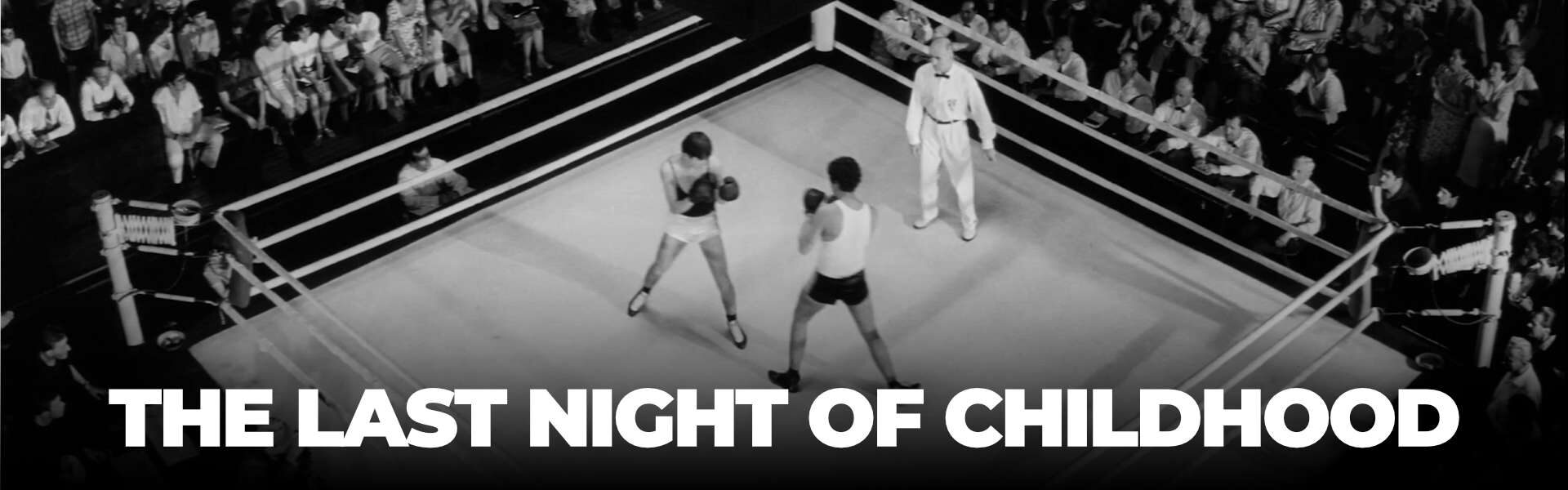
• “What are you thinking? (…) Do I look like the head of a family? I want to be a boxer, not a babysitter.” – Max (Cornel Guriță)
• “I should say a few words. But I prefer to sing, it’s easier. A song I wrote for one person, but songs are made for everyone.” – Lucian (Liviu Tudan)
• “I’m glad you didn’t come to the seaside. Because then I would never have been able to go there again.” – Lucian (Liviu Tudan)
• “When someone knows you, it’s very easy to become a jerk, a coward.” – Lucian (Liviu Tudan)
• “Lucian, I know you’re at an age when many of the things you don’t understand revolt you. That doesn’t mean you have to become hateful.” – Dr. Vlad Dognaș, Lucian’s father (Vincențiu Grigorescu)
• “I think the purest thing in life is childhood. And we should keep it inside us for our whole lives.” – Lucian (Liviu Tudan)
ARTICLES:
- • The Last Night of Childhood – blogdefilm.ro
• Rebel and communist. The maladjusted youth in Romanian cinema (1948–1989) – istoriafilmului.ro
• Man of the day: Savel Știopul – jurnalul.ro
• How director Savel Știopul tricked the authorities into allowing him to present the uncensored version of “Falansterul” at Cannes – adevarul.ro
• A vocation for art, a vocation for life – jurnalul.ro
• Dumitru Carabăț has passed away – agenda.liternet.ro
• Dumitru Carabăț, the last script – iquads.ro
• Going to the movies retains some of its charm as a social experience – gazetaneuma.ro
This premiere is part of a national archive project supported by the Romanian National Film Centre.
Special thanks goes to the Romanian Filmmakers Union and to the Romanian Film Archive.


