
Synopsis
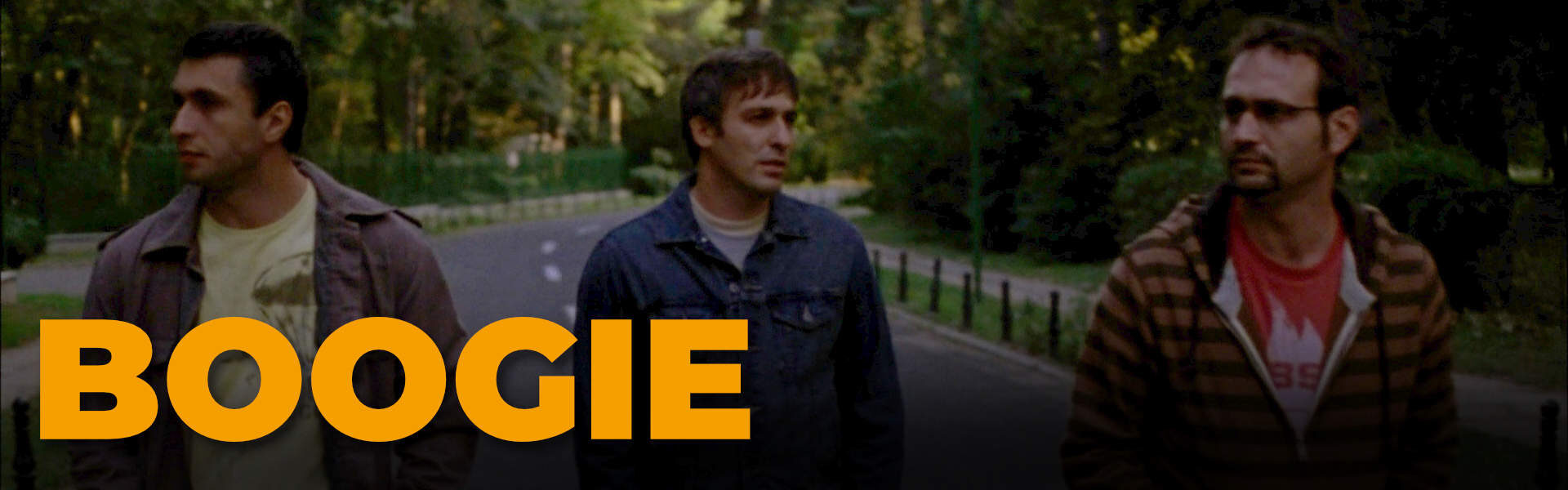
Foreword: A sort of John Cassavetes-style “Husbands,” set by the seaside on May 1. Dragoș Bucur, Mimi Brănescu, and Adrian Văncică are three high school friends who reunite in their late 30s and party like they’re 17. Except life isn’t quite what it used to be.
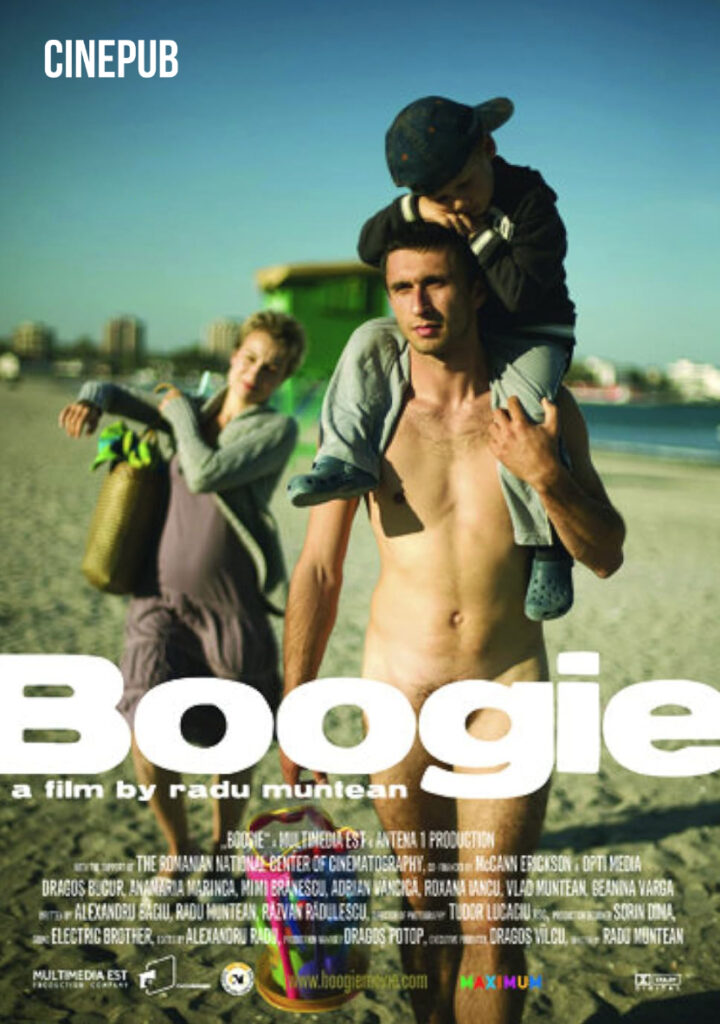
Directed by: Radu Muntean
Script by: Radu Muntean, Alexandru Baciu, Răzvan Rădulescu
Cast: Dragoș Bucur, Anamaria Marinca, Mimi Brănescu, Geanina Varga, Adrian Văncică, Alexandru Potocean, Valentin Antofi
Producer: Multimedia Est / Antena 1
Cinematography by: Tudor Lucaciu
Edited by: Alexandru Radu
Sound: Dragoş Stanomir, Marius Cozma
Year: 2008
Category: Feature film
Genre: Drama
Duration: 102 minutes
PLOT SUMMARY
While on vacation at the seaside with his wife (Anamaria Marinca) and their 3-year-old child, Bogdan Ciocazanu (Dragoș Bucur) runs into his best friends from high school at the very place and time that hold memories of their most glorious drinking and sexual escapades from their youth. After dinner, Bogdan (Boogie) finds himself torn between his family obligations and the temptation to relive an evening just like in the good old days.
AWARDS
- 2008 – Selected for the Directors’ Fortnight section at Cannes
- 2008 – Essonne – Special Jury Prize
- 2008 – Hamptons – Best Screenplay Award
- 2008 – Palic – Special Jury Mention
- 2008 – Anonimul – Best Director Award
- 2008 – UCIN – Best Director Award
- 2008 – UCIN – Best Actress in a Leading Role Award (Anamaria Marinca)
- 2008 – UCIN – Best Actor in a Leading Role Award (Dragoș Bucur)
- 2009 – Gopo – Best Director Award
- 2009 – Gopo – Best Actor in a Leading Role (Dragoș Bucur)
- 2009 – Gopo – Best Actress in a Leading Role (Anamaria Marinca)
- 2009 – Gopo – Best Actor in a Supporting Role (Mimi Brănescu)
DIRECTOR’S STATEMENT
“It’s the story of men in their thirties who, even if just for one night, still think of themselves as teenagers. (…) They lack absolutely nothing. However, I believe that the social pressure felt by men and women who are now in their thirties is greater than that of previous generations. These are people who came of age alongside the revolution, who spent the first part of their youth in the world before ’89, and who are now struggling to adapt to the mutating capitalism of present-day Romania. Hence the frustration that they are no longer masters of their own time and that responsibilities often overwhelm them.” – Radu Muntean, in an interview with Iulia Blaga, agenda.liternet.ro
“(Romanian women) hysterical?… No, not at all. They are much closer to the Western model of womanhood than perhaps our mothers were at the same age. They are no longer the women of the kitchen as in the old days; they are much more independent, more eager to achieve professionally. Of course, this often conflicts with family obligations and with the mentality of the Romanian man, who often does what he saw his parents do: he tries to dominate his woman.” – Radu Muntean, in an interview with Iulia Blaga, agenda.liternet.ro
CRITICAL REVIEWS:
“It’s the most authentic snapshot of a crisis in an ordinary couple’s relationship that I’ve seen in Romanian cinema (the nighttime argument between Bucur and Marinca is legendary!). A mature film about the Present and the Past that is present (fortunately or unfortunately) within it.” – Alex. Leo Șerban, agenda.liternet.ro
“It’s a post-minimalist film, but one designed to be so; I don’t know if it draws from Puiu (Cristi) or from something else — Puiu’s sources, the Italian-French genre (neorealism, Antonioni, Nouvelle Vague, Bresson).” – Alin Ludu Dumbravă, agenda.liternet.ro
“Muntean is a virtuoso conductor of complex dialogue sequences, and his method is as subtle and non-manipulative as possible. He doesn’t cut from one character to another to highlight potential conflicts between them, nor does he zoom in on one or the other to emphasize that one said something foolish or that the other doesn’t agree.” – Andrei Gorzo, agenda.liternet.ro
“There are two criticisms most frequently leveled at recent Romanian films: that they focus primarily on the misery and violence in our society (in other words, they are more realistic than they should be) and that they deal exclusively with communism and the Revolution (without which, it is said, they would not succeed ‘abroad’). Radu Muntean’s “Boogie” proves once again how unfounded these criticisms are — often coming from armchair critics who pose as know-it-alls.” – Mihai Fulger, agenda.liternet.ro
“The heroes of ‘The Paper Will Be Blue’, who escaped the revolution and plunged headfirst into capitalism — or whatever it is — have reached their late 30s, thoroughly exhausted. Or, at least, that’s how they seem. In any case, they’re caught between two worlds. They don’t feel at home either in the atmosphere of the disco, with its deafening music, or in adult life, with its responsibilities and problems.” – Iulia Blaga, agenda.liternet.ro
“Muntean manages the feat of making, after many years in which the ills and pains of the communist and post-communist eras ruled the roost in Romanian cinema (the quality and impact of this ‘rule’ remaining, however, debatable), a film of a banal — but oh so refreshing! “normalcy”. – Mihai Gădălean, agenda.liternet.ro
“But I’ll stop here and repeat: ‘Boogie’ isn’t a film you’re supposed to ‘like’. It’s too close to home to like and too unbearable not to like. It’s a portrait of a moment in any man’s life, when he finds himself trapped in the throes of a certain age, his gaze turned toward the childish joys he once loved so dearly and his mind too firmly anchored in the responsibilities of the present. A dilemma with a single (and correct) resolution in the film, but with hundreds of other possibilities the moment you step out of the movie theater.” – Eduard Țone, agenda.liternet.ro
“Without any stridency, without a hint of melodrama, and without the slightest intention of ‘artistically’ embellishing the truth, the story written by Răzvan Rădulescu, Alex Baciu, and Radu Muntean carries within it a heart-wrenching sadness that hits you right in the gut, especially since it is written with the authenticity that Romanian cinema has long and seemingly incurably lacked.” – Andreea Chiriac Hentea, agenda.liternet.ro
“At the end of ‘Boogie’, the advice Nicole Kidman gives Tom Cruise in Eyes Wide Shut — to talk less and have more sex — seems slightly sinister. ‘Boogie’ is a must-see. If you’re cynical but still honest, you’ll find plenty of humor in the misery. If you’re not in the best of moods, you might find yourself frequently touching your neck, chin, and cheeks. I found it hard to believe that Radu Muntean would strike me once again as he did with “The Paper Will Be Blue”. But clearly, he hit the mark again this time!” – Lucian Maier, agenda.liternet.ro
“In a scenario reminiscent of Cassavetes, the three men spend a long, endless night together. The formless structure of the film is captivating, and Muntean hooks viewers with its hyperrealism. When the guys’ camaraderie—their familiar joking and insults—is believable; one quickly understands the nature of their past friendship as ‘Boogie’ flirts with a woman in a charming moment.” – Gary M. Kramer, filmint.nu
“Interestingly, Muntean offers no final reassurance that married life is better than the shallow pleasures of bachelordom. Hard choices and trade-offs must always be made, both for the young and the less young. This is a tough, shrewd, intelligent movie.” – Peter Bradshaw, theguardian.ro
TRIVIA:
- Radu Muntean believes that the reactions of Romanian audiences (at TIFF and Anonimul IFF) were more intense than those at international festivals such as the Cannes Film Festival or the Karlovy Vary International Film Festival, due to nuances in language and cultural context.
- The director sees “Boogie” as a film that “doesn’t leave you indifferent”, sparking heated debates and dividing audiences into camps.
- Originally, the film was titled “30 and Something”.
- This is Radu Muntean’s third collaboration with Dragoș Bucur (following “The Rage” and “The Paper Will Be Blue”) and his first with Anamaria Marinca.
- The story reflects the social pressure on the generation in their 30s, who grew up before and after the 1989 Romanian Revolution, caught between two worlds and conflicting responsibilities.
- The director believes that this generation is not “sacrificed”, but rather privileged because it has experienced major historical changes.
- “Boogie” was conceived in parallel with the film “The Paper Will Be Blue”, with the idea that the characters from that film could evolve over time into those in “Boogie”.
- Radu Muntean is actively involved not only in directing and screenwriting, but also in production and promotion — a practice typical of European auteur cinema, especially under limited-budget conditions.
- The director estimates that a successful Romanian film realistically reaches 20,000–50,000 viewers, reflecting the difficulties of the local film market.
LINES:
• “He has no patience. He has no interest in anything.” — Boogie (Dragoș Bucur)
• “I wish you all a happy Labor Day!” — Boogie (Dragoș Bucur)
• “I’ve got a runny nose!” — Adrian (Vlad Muntean)
• “It was cool that they were doing nudism and I was watching them.” — Boogie (Dragoș Bucur)
• “Give me a break with Varna. What’s the difference between Bulgaria and Romania to me!” — Boogie (Dragoș Bucur)
• “Why are we such suckers and don’t start a business with Fluocinolone?” — Penescu (Mimi Brănescu)
• “My fontanelle has opened.” — Boogie (Dragoș Bucur)
• “I’ve gone sour.” — Smaranda (Anamaria Marinca)
• “You can keep sleeping; I’m going out to have fun. Good night.” — Boogie (Dragoș Bucur)
• “Never the fat ones.” — Penescu (Mimi Brănescu)
• “Come on, are you going first? Don’t keep me waiting too long, it’s cold out here.” — Penescu (Mimi Brănescu)
• “You’re my best friend; but also the biggest jerk.” — Iordache (Adrian Văncică)
• “Do you think everyone grew up in Cotroceni?” — Iordache (Adrian Văncică)
• “Look, man, Ceaușescu’s villa!” — Penescu (Mimi Brănescu)
ARTICLES:
- Review: “30 and Something”, by Alex. Leo Șerban – agenda.liternet.ro
- Review: “Radu Muntean Initiates Change”, by Mihai Fulger – agenda.liternet.ro
- Review: “To Boogie or Not To Boogie”, by Alin Ludu Dumbravă – agenda.liternet.ro
- Review: “I Like to Boogie…” – agenda.liternet.ro
- Review: “Escape”, by Andrei Gorzo – agenda.liternet.ro
- Review: “Boogie Knights”, by Mihai Gădălean – agenda.liternet.ro
- Review: “Hundreds of Variations”, by Eduard Țone – agenda.liternet.ro
- Review: “Boogie or the Nostalgia of Youth”, by Andreea Chiriac Hentea – agenda.liternet.ro
- Interview with Radu Muntean: “We Make Films for Romanians, and Romanians Don’t Go to the Movies Anymore”, by Iulia Blaga – agenda.liternet.ro
- Review: “Rien ne va plus”, by Lucian Maier – agenda.liternet.ro
- “Boogie” (2008) – istoriafilmuluiromanesc.ro
- “Boogie”, selected for the European Film Academy Awards – mediafax.ro
- “Boogie”, awarded in France – mediafax.ro
- “Boogie”, in competition at the Hamptons International Film Festival – mediafax.ro
- “Boogie” (2008) – filmint.nu
This premiere is part of a national archive project supported by the Romanian National Film Centre.
Special thanks goes to the Romanian Filmmakers Union and to the Romanian Film Archive.


