
Synopsis
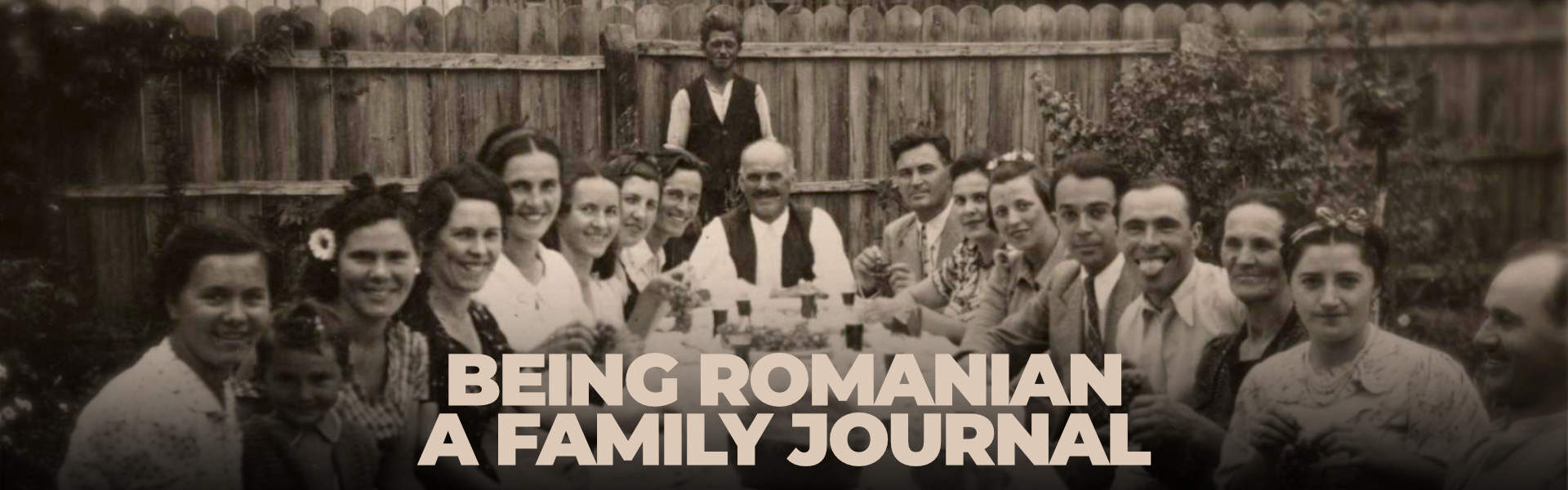
Foreword: The story of a nation told by those who lived it, not those who wrote it. A hundred years seen through the life of the -escu family, a reflection of any Romanian family.
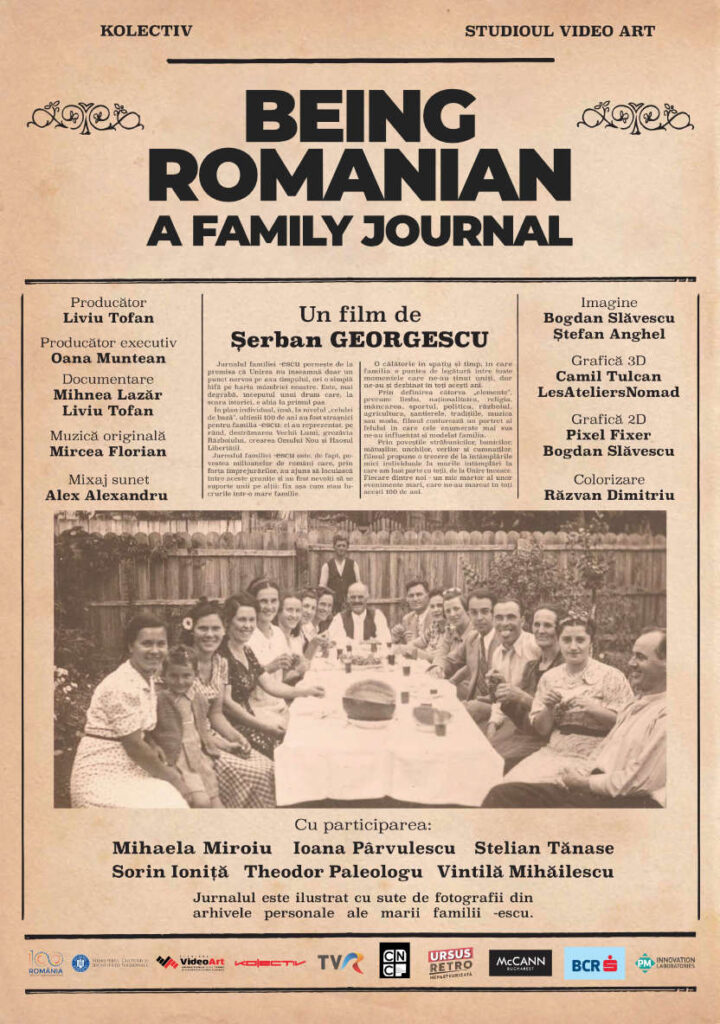
Directed by: Șerban Georgescu
Script by: Șerban Georgescu
Cast: Mihaela Miroiu, Ioana Pârvulescu, Stelian Tănase, Sorin Ioniță, Theodor Paleologu, Vintilă Mihăilescu
Producer: Oana Muntean (co-producer – Victoria Film), Liviu Tofan
Cinematography: Bogdan Slăvescu, Daniel Oprea
Editing: Șerban Georgescu, Cosmin Sebastian
Sound: Alex Alexandru
Music: Mircea Florian
Year: 2019
Category: Feature film
Genre: Documentary
Duration: 95 minutes
12,706 – Cinepub viewers
PLOT SUMMARY
“Being Romanian: A Family Journal” starts from the premise that the Great Union of 1918 is not just a nervous point on the axis of time, or a simple check mark on the map of our pride. Rather, it is the beginning of a journey that, on the scale of history, is only just getting started.
On an individual level, however, at the “basic cell” level, the last 100 years have been terrible for the -escu family: they have represented, in turn, the collapse of the Old World, the horror of War, the creation of the New Man, and the Chaos of Freedom.
“Being Romanian: A Family Journal” is, in fact, the story of millions of Romanians who, by force of circumstance, came to live within these borders and were forced to put up with each other: just as things are in a large family.
A journey through space and time, in which the family is the bridge between all the moments that have kept us united, but have also divided us over the years.
By defining a few “elements”, such as language, nationality, religion, food, sports, politics, war, agriculture, construction sites, traditions, music, or fashion, the film paints a portrait of how the above have influenced and shaped our family.
Through the stories of our great-grandparents, grandparents, aunts, uncles, cousins, and brothers-in-law, the film proposes a transition from small individual events to the major events we have all been part of since the Union. Each of us is a small witness to major events that have marked us throughout these 100 years.
AWARDS
- 2019 – Râșnov Film and History Festival – Audience Award
- 2019 – Râșnov Film and History Festival – High School Jury Award
FESTIVALS
- 2020 – Gopo Awards – Nomination for “Best Documentary Film”
CRITICAL REVIEWS:
- “Just as educational booklets were published in the past, Șerban Georgescu tells ‘History for Everyone’, a personal, dynamic story, told with humor and self-irony, sadness and understanding. For -escu, history is not an abstract and glorious thing, but life as it is every day.” – Dana Medar, aarc.ro
- “The result is a lively portrait of Romania yesterday and today. Although lacking in visual appeal, “Being Romanian: A Family Journal” shows that you can make an inventive documentary from an abstract idea. A documentary essay that treats, without pomposity, but rather with humor, a subject that is as important as it gets, almost an obsession of this people—the definition of their own identity, between pride and self-mockery.” – Ionuț Mareș, ziarulmetropolis.ro
- “With a wealth of material gathered from film archives, complemented not only by the author’s witty commentary, delivered in the first person, the film represents a decoding of Romanian mentalities, attitudes, and behaviors that have led us to slip, somehow, through a history that was not smooth or clear, but challenging and full of contradictions, which our family of ‘Romanians, more or less honest’ (in the words of the immortal Caragiale) has gone through, consumed, and enriched, in a lively, multilateral national pride.” – Bogdan Burileanu, agenda.liternet.ro
- “Georgescu’s documentary describes, starting from his family, which was elevated to the status of a model family, the important stages of the 20th century. From the unification of the Romanian provinces to the difficult situation of women during the Ceauşescu era, from the lost words of different dialects to the artificial homogenization of traditional clothing under national communism, the striking social and anthropological realities of the last century of Romanian history flash rapidly before the viewer’s eyes.” – Cristian Caloian, agenda.liternet.ro
- “A unique appearance. It does not talk about leaders, glorious battles, ‘landmark events’. It is the history of the middle-class man who strives to fight for his family, dignity, well-being, that is, survival. The -escu family could be any of us, regardless of time, nationality, religion, with everyday sacrifices. Șerban Georgescu recounts, with humor or sadness, the hundred-year history of his family and others.” – Dana Medar, aarc.ro
- “The film’s great merit does not lie in its informative aspect — nothing it presents is unknown to an informed or knowledge-seeking audience. Its success lies in the tone of a grandfather telling his grandchildren the family history, in which the individual is connected by thousands of threads to those close to them and those less close.” – Cristian Caloian, agenda.liternet.ro
- “This is not a textbook lesson, and clichés are used only to be deconstructed. Nor is it a demonstration of the exceptionalism of a family, as a typical documentary would probably have attempted to do.” – Ionuț Mareș, ziarulmetropolis.ro
TRIVIA:
- Șerban Georgescu has over 20 years of experience in documentary and advertising, as well as ongoing collaborations with producers in Norway, Denmark, and Switzerland on internationally acclaimed films.
- “Jurnalul familiei –escu” ( Being Romanian: A Family Journal) began at the invitation of Laurențiu Damian and Marilena Ilieșiu, as a film dedicated to the Centenary.
- The concept of the film was born out of a desire to tell the history of the last century through the eyes of the “ordinary man” — the anonymous “-escu” who make up the nation.
- The director was looking for a completely new approach, having already worked on the theme of 1918 in the series “Dinastia” (The Dynasty).
- He was given complete creative freedom, including the use of humor, an element that is also part of his previous style.
- The film functions as a personal and family diary, not as an exhaustive history — a choice made to avoid the “pitfalls of objectivity.”
- The making of the film coincided with “middle age” questions: identity, roots, the simultaneous experience of being a son and a parent.
- Working with family photo archives — his own and a large number received from the public — Georgescu reflected on the unknown lives behind the seemingly mundane faces.
- A touching memory: a photograph of King Michael was kept on the wall of his grandmother’s house even during communism, hidden only discreetly.
- Towards the end, the film includes an emotionally charged moment: his complicated relationship with his father and the unanswered questions from the 1950s.
- The line “fortunately, my father didn’t live to see Iliescu’s second term” comes from an inside joke used by father and son to make the approach of death bearable.
- The director tests his ideas on his own daughter, who becomes a “guinea pig” to understand the reaction of teenagers — a method that has proven effective.
- Educational tours with “Cabbage, Potatoes, and Other Demons” have shown him that young people watch documentaries carefully and are eager to discuss them, contrary to prejudice.
- The key message for teenagers: living together in a nation is a difficult but formative exercise; identity becomes richer only through dialogue and openness.
- The director believes that Romania has not yet honored the anonymous heroes of 1989 and that there is a lack of cultural rituals and films that make them relevant to young people.
- An example of an ignored story: Aurel Popescu, the pilot who fled Romania with his family in an AN-2, flying extremely low to Austria — a “Hollywood subject” that still has no Romanian film.
LINES:
• “I left the history Olympics defeated. Because… it repeats itself.” – Șerban Georgescu
• “That ‘-escu’ was a way of marking the family’s age and nobility. It is the equivalent of ‘de’ or ‘von’ in Romanian.” – Theodor Paleologu
• “Language is a political construct. As such, it can be used politically.” – Vintilă Mihăilescu
• “For the simple fact that our relatives were scattered across almost every corner of the country, summer vacation meant, for me, a long and chameleonic adventure. And when it ended, I no longer knew whether I was from Transylvania, Oltenia, Wallachia, or simply Bucharest.” – Șerban Georgescu
• “There is a certain Moldovan sluggishness that I know from my family.” – Theodor Paleologu
• “(Under communism) you could buy anything you wanted on the black market. This divided the population – those who had access to these third-party sources and those who did not. It made some of us hate each other.” – Stelian Tănase
• “Meals were extremely important for the -escu family. They would change for meals. When it was lunchtime, especially, the most important meal, it brought the whole family together.” – Ioana Pârvulescu
• “Traditions are our selection from a past that has reached us. A selection according to our current tastes.” – Vintilă Mihăilescu
• “Football is a team sport, so, by definition, it cannot be done well by Romanians. We are good at everything that is solitary. Great performances are individual.” – Theodor Paleologu
• “It’s Hagi’s performance, not the Romanian team’s performance.” – Theodor Paleologu
• “Fortunately, (my father) didn’t live to see Iliescu’s second term.” – Șerban Georgescu
• “(Dad) I knew he had studied hard to leave the village, but I didn’t understand why he ended up in a factory.” – Șerban Georgescu
• “It was only after the Revolution that I learned the story of the liberal student who was arrested, who lost almost everything, whose dreams were shattered, who started over after years of frustration and hardship, and who never told me anything.” – Șerban Georgescu
ARTICLES:
- Chronicle of the ordinary Romanian – aarc.ro
- What it means to be Romanian – ziarulmetropolis.ro
- Looking back with irony – agenda.liternet.ro
- Therapy through cinema – agenda.liternet.ro
- Being Romanian: A Family Journal – tvr.ro
- Exclusive interview with Șerban Georgescu – zilesinopti.ro
- Being Romanian: A Family Journal – peliculaculturala.ro
- Being Romanian: A Family Journal – kolectiv.ro
- Șerban Georgescu, director of the documentary film “Being Romanian: A Family Journal”, was on Espresso today – radioromaniacultural.ro
- “Being Romanian: A Family Journal” will also be screened in Constanța – adevarul.ro
- “Being Romanian: A Family Journal” – formula-as.ro
- “The Silence of Others” and “Being Romanian: A Family Journal” won the documentary film competition at the Râşnov Film and History Festival, 2019 – agenda.liternet.ro


