
Synopsis
Foreword: Produced in 1984, “Happy Lament” (dir. Mircea Moldovan) is based on the play staged in the same format (Mircea Moldovan, director, and Sűtő András, playwright/screenwriter) with a slightly longer title – “Bocet vesel pentru un fir de praf rătăcitor” (Happy Lament for a Wandering Speck of Dust).
Presumably, the convoluted and pleonastic formula was intended to encompass the Mioritic “laughing through tears” and Shakespeare’s “Much Ado About Nothing.” (Augustin Cupșa, cinepub.ro)
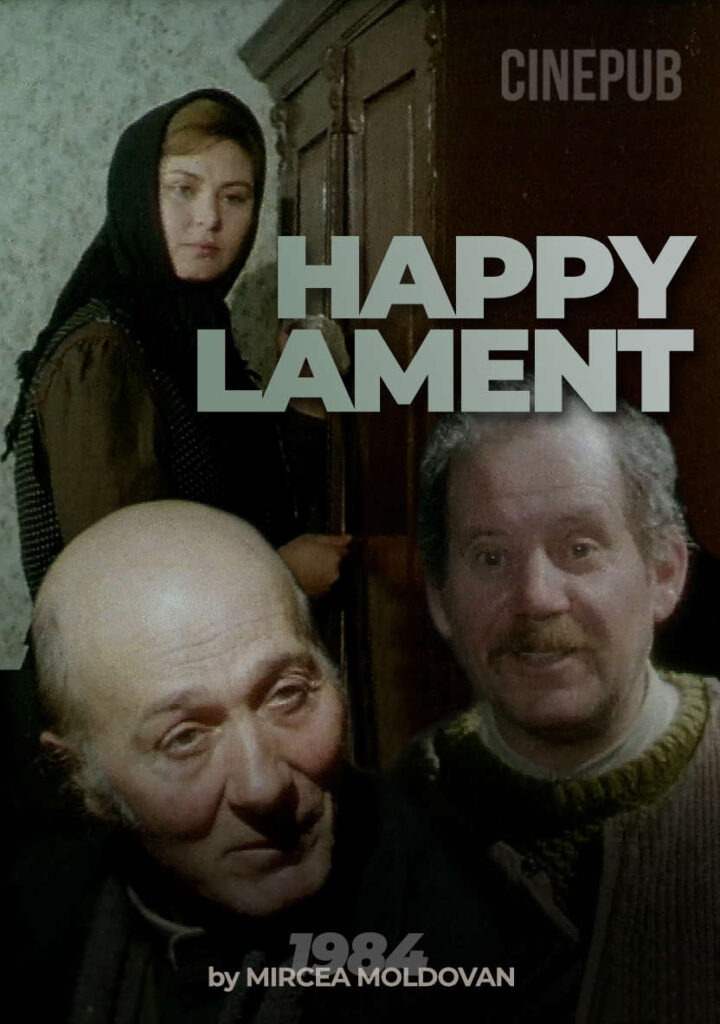
Directed by: Mircea Moldovan
Script by: András Sütő, Mircea Moldovan
Cast: Aristide Teică, Alexandru Lungu, Florina Cercel, Dem Rădulescu, Tamara Buciuceanu-Botez, Tania Filip, Paul Lavric, Nicolae Dide, Maria Constantinescu
Producer: Titi Popescu, Dumitru Solomon
Cinematography by: Liviu Pojoni
Edited by: Gabriela Nasta
Sound: Andrei Papp
Music: Tiberiu Olah
Year: 1984
Category: Feature film
Genre: Comedy
Duration: 82 minutes
PLOT SUMMARY
In a Transylvanian village, a pastor tries to convert a local peasant to his religion, for personal interests.
CRITICAL REVIEWS:
“In its need for affirmation, the film, like the play, loses its nuance of compassion for this sad reality, going too far with gratuitous humor and caricaturing certain characters. The preacher ends up resembling a clown, and the message to the faithful is emptied of content until it begins to sound like political doublespeak. Romanian mythological figures become vividly colored puppets who try, without success, to brighten up the ideologically frozen landscape. The Romanian saying “râsu` plânsu`” (laughing through tears) should have been understood as a state of balance, humanity, and tolerance. Perhaps things will be better from now on, in more forgiving times.” – Augustin Cupșa, cinepub.ro
“Director Mircea Moldovan […] I don’t think he found the cinematic ‘key’ to this ‘Happy Lament’. […] We are left with lines such as ‘sin is not what goes into our mouths, but what comes out of them’, and we think beyond the film, about the powerful vein of serious authenticity and ironic wisdom in Sütő’s dramaturgy.” – Călin Căliman, in the magazine “Contemporanul,” no. 7, February 10, 1984, p. 13.
“The camera operator Liviu Pojoni leans more towards landscape poetry than towards exploiting the burlesque situation; a composer of Tiberiu Olah’s caliber displays a playful spirit that we did not suspect he had. Don’t get me wrong, God forbid! (we are still in the midst of anti-obscurantist satire, only that the theme is too important to be trivialized with such superfluous treatment) that I am dismissing the farce from Parnas, or that after this experience I doubt the comic talent demonstrated in “The Freshmen’s Autumn” by the director. It’s just that here he has somewhat lost his sense of proportion.” – Alice Mănoiu, in the magazine “Cinema” no. 2, February 1983
“In the feature film “Happy Lament”, the changes related to the specificity of visual language are minimal; but the natural reduction of dialogue diminishes the metaphorical relief that exists in András’s sentence structures […]. The redrawing—different from the play—of some destinies, the ‘enrichment’ of biographies, or the reversal of some situations does not clarify the filmic discourse, but rather weakens it. […] The evolution of the characters remains difficult to believe, not only within certain episodes, laboriously linked in time, but also in the unfolding of the entire action.” – Ioana Creangă, in the magazine “România literară”, year XVII, no. 8, Thursday, February 23, 1984, p. 17.
“[…] I find the film to be a rather superficial interpretation of Sütő’s work, losing sight of the philosophical significance of the work and the psychological depth and complexity of the characters.” – Zeno Fodor, Steaua Roșie magazine, year XXXV, no. 38, February 15, 1984, p. 2.
“Long experience confirms that what was written for the stage belongs to the stage: transfer is almost always a risky business.” – O. T., “Film – Vidám sirató,” in the magazine Vörös zászló, year XXXVI, no. 38, February 15, 1984, pp. 2–4.
“We will therefore encounter “Happy Lament”, folk theater, a “peasant environment”, and comic accents — the film intended to be a satire of morals aimed at the naive who still believe in the twisted words of opportunistic (and self-serving) preachers.” – Nicolae Ulieriu, in the magazine “Săptămâna”, February 17, 1984
TRIVIA:
- The film is inspired by András Sütő’s play from 1977, created by combining two of the author’s previous dramatic texts.
- The original play, set in a Transylvanian “metapeisage” typical of Sütő’s work, ironically comments on neo-Protestant cults and mechanisms of collective adherence in a social satire influenced by The Decameron.
- András Sütő initially collaborated on the screenplay, but later contested some changes in the final version and stated that he did not participate in the making of the film.
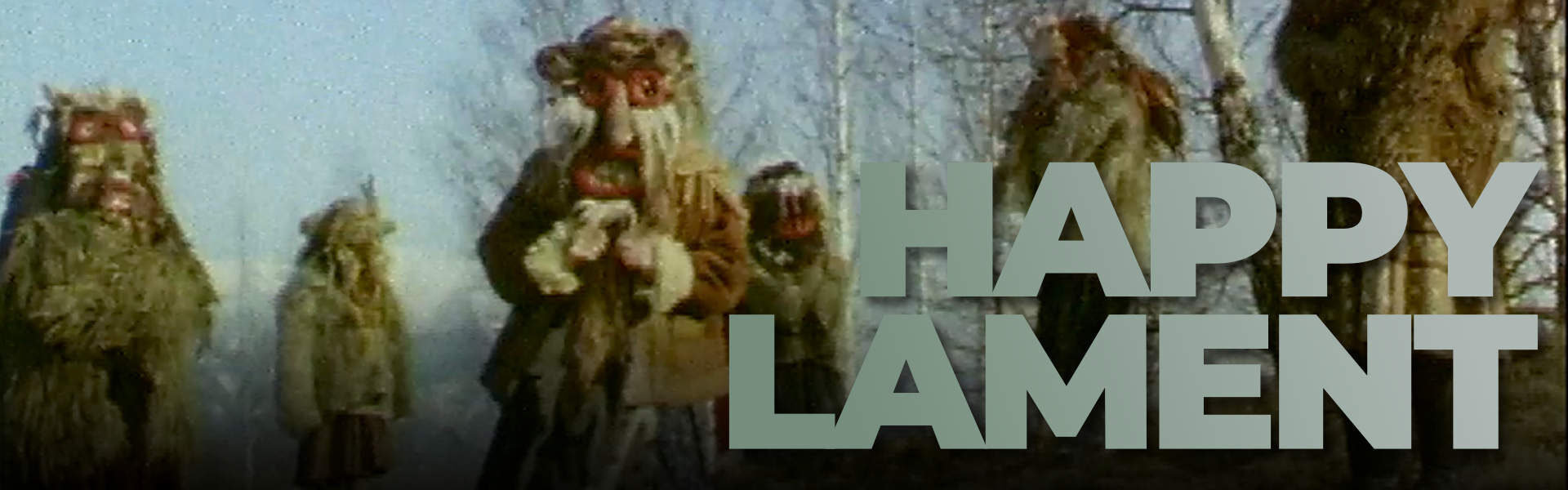
- Director Mircea Moldovan substantially modified the story for the screen: he introduced the plot related to the election of the C.A.P. president, moved the action to a contemporary setting, and added carnival elements (such as the masked singers at the beginning).
- The scenes with Dem Rădulescu and Tamara Buciuceanu were introduced to increase the length of the film, but also to increase the commercial appeal of the production.
- Filming took place in 1983, with Liviu Pojoni as director of photography and Tiberiu Olah as composer.
- The main roles were played by Aristide Teică and Alexandru Lungu, without the Hungarian actors who had played in the theatrical productions of the play.
- The premiere took place on February 6, 1984, and the film was seen by over 1.5 million viewers, one of the largest audiences for Romanian productions in the 1980s.
LINES:
• “Elections are being held at collective farm. … you will be the new president. Don’t ask me how I know!” – Isăilă (Dem Rădulescu)
• “But you should know that I can only stay… until tonight!” – Isăilă (Dem Rădulescu)
• “A president must be cultured. Look here: a course on corn cultivation, a course on animal husbandry, a course on first aid, a course on atheism.” – Károly (Alexandru Lungu)
• “Have you heard of Diogenes?” – The Preacher (Aristide Teică)
• “Follow the example of Diogenes, who didn’t go to the theater and didn’t smoke.” – The Preacher (Aristide Teică)
• “You’re a womanizer, a liar (…), a common lecher.” – Ema (Florina Cercel)
• “Even Christ’s coffin was not guarded for nothing. – Ema (Florina Cercel)
• “Sin is not what goes into our mouths, but what comes out of them!” – The Preacher
• (Aristide Teică)
• “It’s a sin to spoil good wine. We followed the rules: first we drank it with water, then we continued without, and now we drink it like water!” – Károly (Alexandru Lungu)
• “You are drunk as pigs.” – Ema (Florina Cercel)
• “I don’t want to be a servant of God, I want to be president of collective farm.!” – Károly (Alexandru Lungu)
• “You’re drunk, you drunken mule!” – The Preacher (Aristide Teică)
ARTICLES:
- Happy Lament for a stray speck of dust/ 1980-1981 – tnamtdigital.ro
- Review: “A postman… in trouble”, by Mădălina Stănescu – aarc.ro
- Review: “Happy Lament”, by Nicolae Ulieriu – aarc.ro
- Review: “Happy Lament”, by Alice Mănoiu – aarc.ro
This premiere is part of a national archive project supported by the Romanian National Film Centre.
Special thanks goes to the Romanian Filmmakers Union and to the Romanian Film Archive.


