
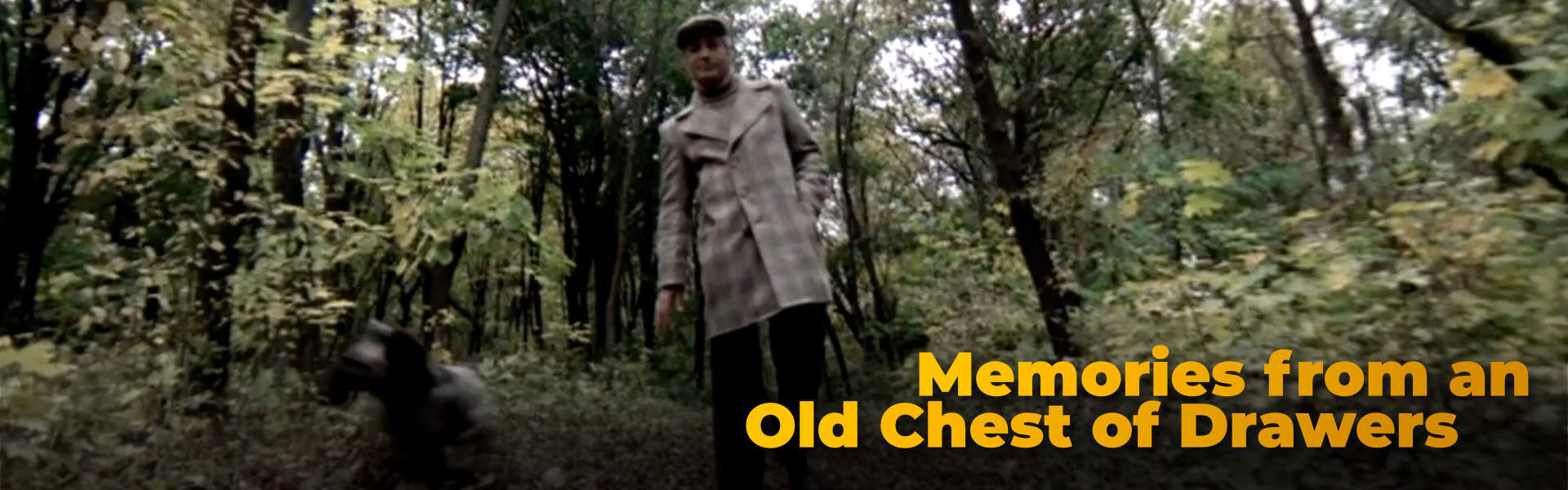
Synopsis
Foreword: Somewhere between decadent elegance and period propaganda, the film “Memories from an Old Chest of Drawers” transforms George Călinescu’s world into a sweeping fresco depicting the collapse of the Romanian aristocracy. One of the most ambitious and challenging projects in Romanian cinema of the 1980s.
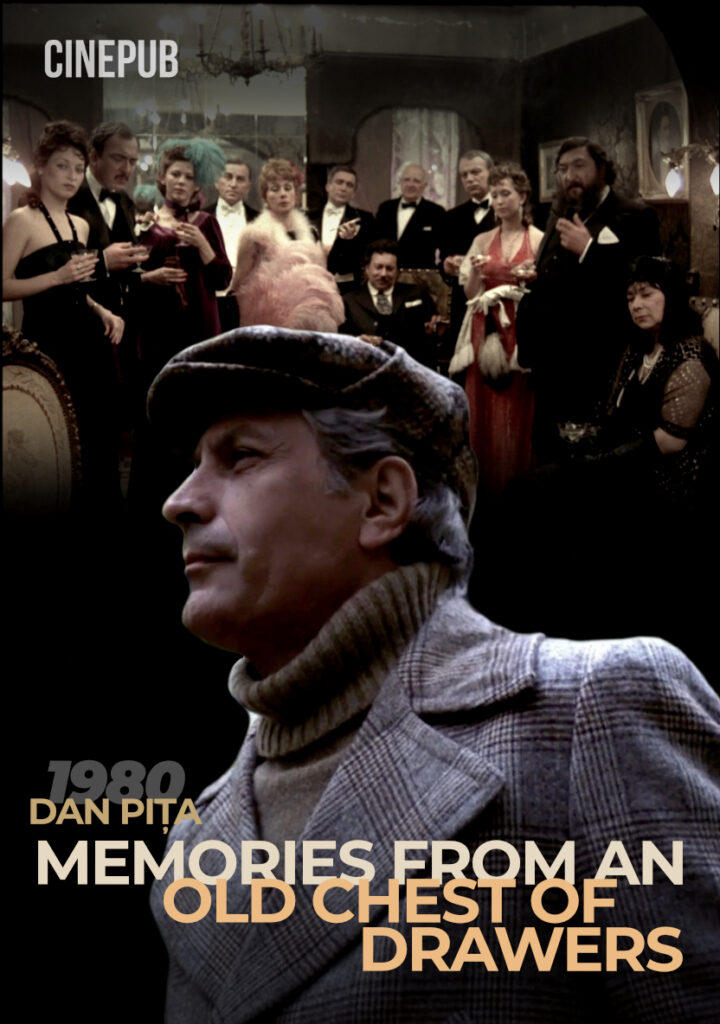
Directed by: Dan Pița
Script by: Eugen Barbu (inspired by the novels “Poor Ioanide” and “Black Chest” by George Călinescu)
Cast: Ion Pacea, Constantin Codrescu, Marga Barbu, Petre Gheorghiu, Tănase Cazimir, Octavian Cotescu, Ștefan Iordache, Gheorghe Dinică, Olga Tudorache, Leopoldina Bălănuță, Beate Fredanov, Jean Lorin Florescu, Carmen Galin, Ion Caramitru, Ovidiu Iuliu Moldovan, Anda Călugăreanu, Mircea Constantinescu, Ion Besoiu, Dinu Ianculescu, Mihai Pălădescu, Mircea Diaconu, Livia Ungureanu Doljan, Adrian Georgescu, Ileana Codarcea, Dorel Vișan, Zizi Șerban, Andrei Codarcea, Mihai Dobre, Dan Nasta, Elisabeta Adam, Lucia Cosmeanu Maier, Alexandru Perghe, Aurelia Sorescu Lipatti, Lucian Iancu, Constantin Popa, Dumitru Palade
Producer: Platon Pardău
Cinematography by: Florin Mihăilescu
Edited by: Cristina Ionescu
Sound: Bujor Suru
Music: Adrian Enescu
Year: 1980
Category: Feature film
Genre: Drama
Duration: 141 minutes
PLOT SUMMARY
Ioanide, an apolitical and misunderstood artist who dreams of “things that are normal abroad but impossible here”, led a difficult life as an architect under the old regime. After 1944, his situation improved thanks in part to the appreciation of an enlightened communist nicknamed Boticelli, whom he had once hidden from the police in the attic of his home. He received commissions for major cultural monuments, even though he carried the burden of his children’s involvement in the Legionary movement, and continued to surround himself with a circle of sycophants from the former elite. (Tudor Caranfil, “Universal Dictionary of Films”, 2008, Litera Publishing, p. 101)
AWARDS:
- 1980 – ACIN – Award for Art Direction
- 1980 – ACIN – Award for Music
- 1980 – ACIN – Certificate of Honor for Soundtrack (Adrian Enescu)
DIRECTOR’S STATEMENT
“You should know that this was the intention — to turn this film adaptation into a series. Just think, we had six hours of footage. It wasn’t meant to be. In the end, unfortunately, all the footage left out of the film was burned, using the same idiotic excuse: ‘We don’t have space to store leftovers in Buftea!’ ” – Dan Pița
CRITICAL REVIEWS:
“‘It is the most challenging film Dan Pița has made to date; for this majestic epic unfolds successively in tragic and grotesque tones, with the statuesque figures of the future emerging from the turmoil of a time of upheaval, while the dramas of everyday life encapsulate profound ethical and aesthetic debates. In his encounter with the work of George Călinescu, the director brings with him his past experiences and the creative maturity demonstrated in his refined film adaptations — Stone Wedding, “The Spirit of Gold”, and “Tănase Scatiu”. – Ioana Creangă, “România literară” no. 19, May 8, 1980, aarc.ro
“The narrative flow, drawn from the universe of the two novels and structured chronologically, unfolds into countless cinematic sequences; with scholarly professionalism or spontaneous ease, director Dan Pița independently reconstructs each of Călinescu’s portraits, precisely directs their arrangement in space, and masters the play of shadows or vivid colors. He constructs distinct tableaux from within the various episodes — compositions overloaded with faces or snapshots of landscapes viewed from afar (the deserted lake during the hunt or the solitary tree at the fake funeral).” – Ioana Creangă, “România literară” no. 19, May 8, 1980, aarc.ro
“Another ‘dramatic character‘ brought to life in the film is the music. The film features a 16-bar theme that lasts 15 seconds. Composer Adrian Enescu orchestrated it in n variations, giving it n forms, ranging from one instrument to two instruments, to a quartet, and finally to a full orchestra.” – Marian Rădulescu, November 1999 – agenda.liternet.ro
“In ‘Memories from an Old Chest of Drawers‘, beyond the intensity of the dramas experienced by the genius creator or the ordinary man, one senses a certain penchant for the spectacular, for reactions that reverberate outward. But the director consistently dominates the ‘intense’ scenes, balancing them with the following ones, with sequences of contemplation; for Ioanide (portrayed by the painter Ion Pacea and masterfully voiced by the actor George Constantin), always at the center of events, meditates at length before participating with serene detachment in both serious events and amusing adventures; he continually reflects on his sensations and beliefs, without re-shaping them — as in novels — through unpredictable attitudes.” – “România literară” magazine, May 8, 1980
“The film impresses with the density of each frame’s composition, through a panopticon of emblematic figures, in which we sense the artistry of a director who knows how to lend cohesion and depth to the image, and no less the sure taste of a screenwriter of stature — Eugen Barbu, who saw in the architect Ioanide a sober and linear observer, sporadically affirming his beliefs through clear dialogue.” – Valerian Sava, Cinema no. 6, June 1980, aarc.ro
“Despite the episodic qualities of the narrative structure and the aforementioned moments of self-transcendence, we are ultimately reminded of the repeated warnings in Călinescu’s text: ‘It would be difficult for an uninformed viewer to figure out who these people are.’ It is an experience of the highest order in our cinema, one that demands to be discussed and re-discussed.” – Valerian Sava, Cinema No. 6, June 1980, aarc.ro
“Unable to select and navigate the vast epic material proposed by George Călinescu, the authors leave their narrative structures at the mercy of the novel’s myriad possibilities, resulting in a disjointed and insubstantial plot that serves merely as a pretext for stylistic exercises. In Ioanide, the painter Ion Pacea has presence, smokes his pipe thoughtfully, is photogenic, and speaks with distinction, but remains detached from the character. The performances of the professional cast add the necessary spice. As for the director, he rounds out his work with cinematic echoes: the leitmotif of a cohort of characters crossing a field, as in “Le charme discret de la bourgeoisie”, a panopticon of masks reminiscent of Iulian Mihu’s films, a sequence alternating the murder of an academic with a cello concert (like the number in “Cabaret”), or other imitations. Otherwise, 15 minutes of idle chatter in the Valsamaki salon, 25 minutes of Balkan exoticism at the flea market (set designer Virgil Moise, ACIN Award), and, after 3 hours of speeches and tirades, the film ends happily to the melancholic strains of Adrian Enescu’s music (ACIN Award).” — Tudor Caranfil
“Discussions regarding the directorial concept between Dan Pița and Film Studio 4 established that the film would be a politically charged biography of an apparently apolitical artist, the architect Ioanide, who journeys from bourgeois interwar individualism to voluntarily joining the machinery of the new socialist world that emerged after World War II. A significant role in the film’s narrative was to be played by the character of the communist Butoescu (later Dragavei), who positively influences Ioanide by raising his awareness of the beneficial role of communists in transforming society. The director conceives a sort of cinematic diptych, consisting of two distinct films, capturing two separate eras: that of the years ’39 – 44, of decadence and the dissolution of the parasitic aristocracy, and that of the early 1950s, in which the remnants of this social class, swept away by the great tide of history, deliriously live out their final moments on the margins of a society with which they no longer share anything.” – Bogdan Jitea, cinepub.ro
“Situated at the intersection of Dan Pița’s artistic vision and the propagandistic intentions of his political patrons, ‘Memories from an Old Chest of Drawers’ demonstrates the freedoms and limitations filmmakers faced in relation to a state-run film industry with which they sometimes clashed, but with which they most often collaborated through ongoing negotiations to produce films that thus came to bear multiple authorial imprints.” – Bogdan Jitea, cinepub.ro
TRIVIA:
- The project to adapt the novels “Poor Ioanide” and “Black Chest” passed through the hands of several directors before being brought to life by Dan Pița. The filmed version was initially over 300 minutes long and could have become a TV series, but the film released in 1980 hit the screens in a version shortened to approximately 140 minutes.
- Filming took place between June and November 1978
- Cristea Avram and George Constantin were considered for the lead role, but in the end, Dan Pița cast the painter Ion Pacea, one of the Ceaușescu family’s favorite artists. The character’s voice was later dubbed by George Constantin. He chose Ion Pacea after seeing him drawing at his easel, considering that he had the naturalness and appearance suited for the character inspired by George Călinescu.
- The film traces the decline of the Romanian aristocracy between 1939 and 1950, constructing a social fresco rather than a classic story. In the second part, the film also introduces the propagandistic perspective of the communist “new order”, with activists portrayed in an idealized light, which Monica Lovinescu described as “transparent shadows of the Absolute Good”.
- Director of Photography Florin Mihăilescu described the film as “a massive, long, and heavy film”, noting in particular the tracking shots and handheld footage in the hunting and chase scenes.
- In retrospect, “Memories from an Old Chest of Drawers” remains a large-scale project, noted especially for its sets, music, and cast, and is considered by critics a true “exercise in style” of Romanian cinema during the communist era.
- The film faced numerous issues with censorship and underwent multiple screenings and revisions before its April 1980 premiere. Director Dan Pița was even accused of deliberately delaying the film’s completion.
- Regarding the character she portrayed in the film, Leopoldina Bălănuță stated in 1978 for the magazine “Cinema”: “For me, Elvira, from the film by Dan Pița and Eugen Barbu, is a character composition, and in this sense she represents an absolute first in my theatrical and cinematic career. That is why I put a great deal of effort into imagining her and then transforming myself into the image I had created. The result: when I look at myself in the mirror, I see another person — it is not me.”
LINES:
• “Man, gentlemen, has become a predator.” — Pomponescu (Octavian Cotescu)
• “Easterners are sentimental, sad beings. They are more like moralistic poets than sarcastic, practical beings.” — Merchant Manigomian (Petre Gheorghiu)
• “Man would accomplish much if it weren’t for life’s hardships.” — Pomponescu (Octavian Cotescu)
• “We often set out in life with the grandest intentions, only to give up in the end.” – Pomponescu (Octavian Cotescu)
• “You deserve for me to build a temple of love for you. The difficulty lies in finding a good sculptor to make your statue.” – Ioanide (Ion Pacea)
• “You’re a bourgeois who wants to marry off your daughter according to your own interests.” — Elvira, Ioanide’s wife
• “Since Michelangelo, nothing special has been invented apart from reinforced concrete.” — Ioanide (Ion Pacea)
• “The difference between a military genius and an ordinary criminal is a millimeter.” — Ioanide (Ion Pacea)
• “We live in times when arms factories are being built rather than theaters and stadiums.” — Ioanide (Ion Pacea)
• “In this world of silence and meditation, there is no place for bullets, bayonets, daggers, or cannons.” — Gonzalv Ionescu, university professor (Gheorghe Dinică)
• “The duty of every devoted woman is to stand by her man in difficult times.” — Pica (Carmen Galin)
• “England and France will be wiped off the map of Europe.” — Tudor, son of Ioanide (Mircea Constantinescu)
• “Blood is the ink with which history was written.” — Tudor, son of Ioanide (Mircea Constantinescu)
ARTICLES:
- Memories from an Old Chest of Drawers – agenda.liternet.ro
- Romanian Theater and Films: “Memories from an Old Chest of Drawers” – agerpres.ro
- Behind the scenes of cinema. How the Ceaușescus’ favorite came to play the lead role in the film “Memories from an Old Chest of Drawers” – adevarul.ro
- Memories from an Old Chest of Drawers (1980) – istoriafilmuluiromanesc.ro
- Review: “The Discreet Charm of the Aristocracy”, by Marian Rădulescu – agenda.liternet.ro
- Review: “Memories from an Old Chest of Drawers”, by Ioana Creangă – aarc.ro
- Review: “Memories from an Old Chest of Drawers”, by Valerian Sava – aarc.ro
This premiere is part of a national archive project supported by the Romanian National Film Centre.
Special thanks goes to the Romanian Filmmakers Union and to the Romanian Film Archive.


