

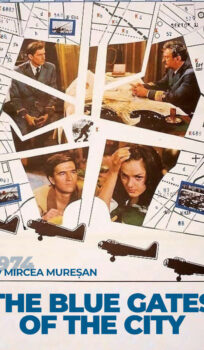
Synopsis
Foreword: “The Blue Gates of the City” is a film about war, about heroism, but above all, a film about humans. (Valerian Sava)

Directed by: Mircea Mureșan
Script: Marin Preda
Cast: Romeo Pop, Costel Constantin, Dan Nuțu, Ion Caramitru, Dumitru Furdui, Amza Pellea, Aurel Ciobanu, Dumitru Rucăreanu, Nicolae Dinică, Dan Damian, Eugen Popiță, Viorel Comănici, Petre Gheorghiu Goe, Matei Alexandru, Jean Lorin Florescu, Florin Scărlătescu, Ștefan Niculescu Cadet, Nucu Păunescu, Emil Reisenauer, Emilia Dobrin
Producer: Marin Theodorescu
Cinematography by: Gheorghe Viorel Todan
Edited by: Maria Neagu
Sound: Nicolae Ciolcă
Music: Doru Stănculescu
Year: 1974
Category: Feature film
Genre: Drama, War
Duration: 95 minutes
187,792 – Cinepub viewers
PLOT SUMMARY
Fresh out of a military hospital where he had been treated for injuries inflicted by a subordinate, Second Lieutenant Roșu (Romeo Pop), a harsh but fair man, returns to command the anti-aircraft artillery battery he led. In the days following the turning of the tide against the Nazis, the unit fought heroically, destroying German fighter planes taking off from Otopeni airport. The reversal of fortune causes his subordinates to change their opinion of Roșu.
AWARDS
- 1974 – ACIN – Award for Best Screenplay (Marin Preda)
- 1974 – ACIN – Special Mention for Best Actor (Ion Caramitru)
CRITICAL REVIEWS:
“It is a real surprise that we now discover, in this heroic film, the serenity of the summer sky, the tranquility of the plains, with delicate August flowers and trumpeters who, wielding their formidable instruments, seem to continue to lead a peaceful, almost imperturbable life.” – Valerian Sava, 1974 (Cinema)
“As in all of Marin Preda’s stories, the apparent, superficial simplicity results from a complex, intimate web of suggestions and issues—numerous, presented more radially than in an epic sequence. The film’s focus moves like a beam on a radar screen, revealing one by one actions that are independent of each other: a persecuted gunner who shoots his superior; a former accountant who goes on leave to try his luck at cards and discovers his wife in the arms of another man; a sergeant humorously recounting exploits that could have cost him his life, and so on. With each return, this radial movement rediscovers the same characters at another point in their adventures.” – Valerian Sava, Cinema magazine no. 4, April 1974
“Uniform under military garb, the human landscape of the film is, in its psychological reality, very diverse. The film, without lacking action, sometimes even successfully relying on suspense and tension, in scenes of war or love, actually belongs to a little-practiced genre that we might call the conversation film. The soldiers, divided into city dwellers and villagers, intellectuals and farmers, engage in a continuous dialogue with polemical subtext, commenting from a double perspective on the adventures of their comrades, the progress of the war, the absence of a cigarette, the movements of the enemy, or the quirks of everyday life, most often in a spirit of mutual tolerance.” – Valerian Sava, Cinema magazine no. 4, April 1974
“The film bears the authorial mark of Marin Preda. Studying the artistic script and the director’s cut in parallel, one can see how Mircea Mureșan did not deviate at all from the letter of the Teleorman writer’s text. Even the unnatural, bookish lines found in the script appear in the film.” – Bogdan Jitea, cinepub.ro
“(…) Another moment of inadequacy in the script that transpires on film is the battle sequence with German troops. In the midst of battle, the protagonists find the time and resources to engage in existential discussions and philosophical reflections. The scene that is supposed to be the climax of the entire war scene is also laughable, with Șerbănescu wearing a suit and gaiters, entering the battle armed with a bag full of grenades, attacking the Germans on his own.” – Bogdan Jitea, cinepub.ro
“The artillery battery appears in the film almost like a band of misfits. In addition to the stubborn soldier Alecu Păun, who is on the verge of assassinating his commander, there is also the gunner Nicolae Șerbănescu, an accountant in civilian life and a bohemian poker addict, as well as the seemingly good-natured sergeant Dumitru Ionescu (Dumitru Furdui), detached from Ploiești after a sordid affair involving a German soldier beaten up by Romanians.” – Bogdan Jitea, cinepub.ro
TRIVIA:
- The film was made in honor of the “30th anniversary of liberation” on August 23, 1944, based on an original screenplay written by Marin Preda.
- Before the final title was chosen, other working titles for the film were also considered: “The Blue Horizon of Death,” “At the Edge of the Sky,” “The Blue Battery,” and “An Hour in August.”
- The first take was shot on August 13, and filming, which took place in Bucharest, Sinaia, Buftea, and Capul Midia, ended on October 23.
- Initially approved on July 9, 1973, the film actually went into production on August 1, only after the script was modified at the request of the Council for Culture and Socialist Education, which demanded, among other things, “the emphasis of anti-fascist sentiments on the part of the battery commander.”
- Regarding communist censorship, Mircea Mureșan stated in an interview for the newspaper “Adevărul”: “After Marin Preda asked me not to change a single word of the script, Cornel (Corneliu Leu, director of Film Studio No. 4) conceived and filmed, in my absence, a short sequence, a miracle of politics: ‘August 24… A man with thick glasses approaches the commander-in-chief of the anti-aircraft defense forces: ‘I come on behalf of the Romanian Communist Party to establish a plan to defend the capital against German aircraft. And he spreads a map on the general’s table.” This while, in the film, the troops at Otopeni were already desperately attacking the Stukas taking off… Anyway, the film was further cut after Dan Nuţu and Dem Furdui “took off” from the country. They called me to redo the editing so that Nuţu and Furdui could be deleted. I explained in writing that this was not possible, that you cannot simply remove two main characters from the film. A certain Bucheru, the director, replied in writing that he would not allow “two traitors to the country” to be shown to the public on the national holiday. I insisted that the film not be shown, but it was shown anyway. Fortunately, they only cut a standard copy, not the negative, so today the film is in one piece again.”
- After completing post-production, director Mircea Mureşan left for the United States on December 16 on a scholarship. In his absence, the film underwent several changes. Documents from the production files at the National Film Archive reveal that on January 28, 1974, “following screenings of the film and discussions with Marin Preda, four changes to the dialogue are to be made to the film negative and working copies.”
- After collaborating with Paul Călinescu as a screenwriter for the film Desfășurarea (1954), Marin Preda took a considerable break from screenwriting due to minor personal failures. “I tried to write a few screenplays that didn’t work out. They didn’t turn out well. The film industry didn’t like them, and in the end, I didn’t like them either, even though I had initially claimed that they could be made. It was only with this film that I realized that in order to write a screenplay that can be made, you shouldn’t overload it; you have to come up with a story that is as concise and simple as possible, which the director can amplify, bringing it to life on screen, because he has the time and space to do so.” (M.P.)
- Actor Romeo Pop, the young man who plays Second Lieutenant Roșu, made his debut in this project.
- The film was seen by 2,517,177 viewers in Romanian cinemas, according to data compiled by the National Center for Cinematography on the number of viewers of Romanian films from the date of release until December 31, 2014.
- On cinepub.ro, you can watch other films by director Mircea Mureșan: “The Uprising” (1965), “Ion, the Lust for the Land” (1980), “Ion, the Lust for Love” (1980), and “Horea” (1984).
LINES:
• “I didn’t laugh, Second Lieutenant. (…) But I can tell you why I’m not crying.” – Soldier Păun (Dan Nuțu)
• “You have no way of knowing if there’s a good one among us. You beat them all.” – Soldier Păun (Dan Nuțu)
• “The army is one and indivisible. And discipline is not our invention, the officers’. How can you tolerate a soldier sleeping on duty?” – Second Lieutenant Roșu (Romeo Pop)
• “It’s not good for my reputation if it gets out that my soldiers hate me so much that they shot at me to kill me.” – Second Lieutenant Roșu (Romeo Pop)
• “The Americans must have come again. It’s 11 o’clock, their time.” – Peasant soldier
• “I have no money left. I have a place in Colentina.” – Soldier Șerbănescu (Ion Caramitru)
• “I wouldn’t stay in Bucharest even if I were tied down. (…) They say they don’t go in ditches or in the grass when they need to relieve themselves. They do it right there, in the house, next door, in a small room.” – Peasant soldier
• “I have to leave for other dream countries, and my train only comes once. If I miss it, goodbye!” – Soldier Șerbănescu (Ion Caramitru)
• “An old woman approached me and said bluntly: Ioane, mother, no one did anything to your Ilena. She was always like that, ugly and with a runny nose. But you didn’t see her. And only after she died and freed you from her spell did you realize who she was.” – Sgt. Ioan Ana (Costel Constantin)
• “I have two children at home. God willing, they will be left without a father.” – Sgt. Ioan Ana (Costel Constantin)
• “I don’t smoke that stuff, man, because it burns my throat. It’s like the smoke goes into my chest with my skin.” – Sgt. Ioan Ana (Costel Constantin)
• “I can shoot even in a suit!” – Soldier Șerbănescu (Ion Caramitru)
• “Hold on tight. We’re at war.” – Second Lieutenant Roșu (Romeo Pop)
ARTICLES:
- “Behind the scenes of cinema.” “The Blue Gates of the City” or how the censors mocked Marin Preda’s screenplay – adevarul.ro
- “The Blue Gates of the City” – Film review (by Valerian Sava) – aarc.ro
- Marin Preda: an enthusiasm for reality (by Valerian Sava) – aarc.ro
- Oh, come on! How Doru Stănculescu opened The Blue Gates of the City and the Flacăra Literary Circle. A heartfelt story – evz.ro
This premiere is part of a national archive project supported by the Romanian National Film Centre.
Special thanks goes to the Romanian Filmmakers Union and to the Romanian Film Archive.


