
Synopsis
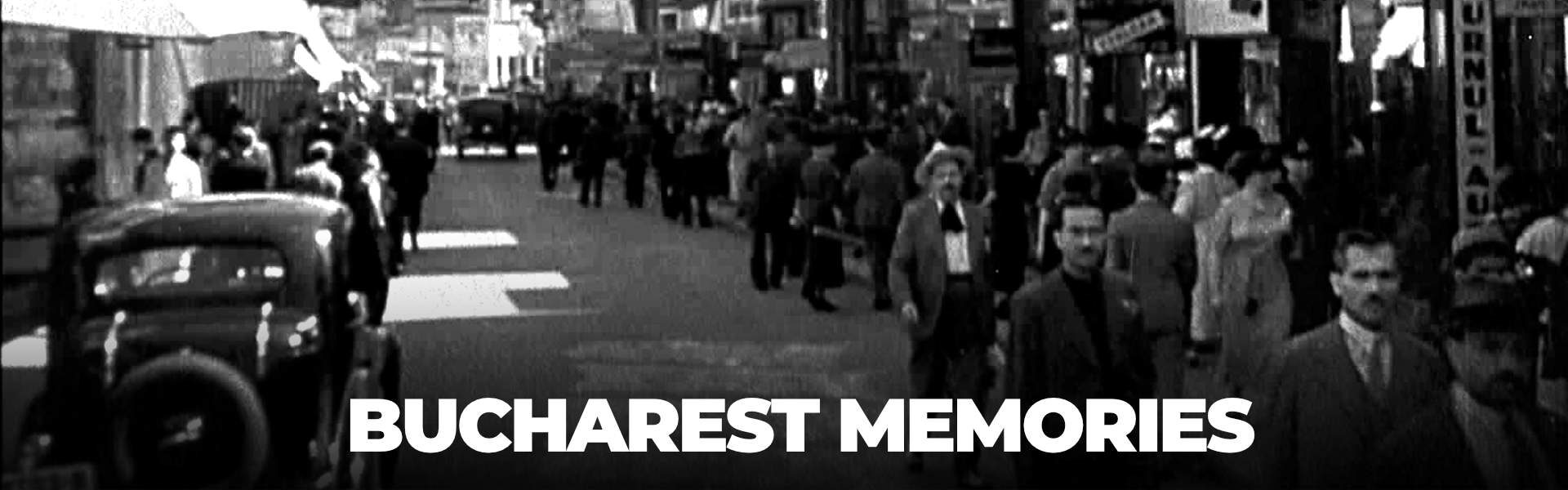
Foreword: A glimpse into the pre-war and interwar world of Romania’s capital city.
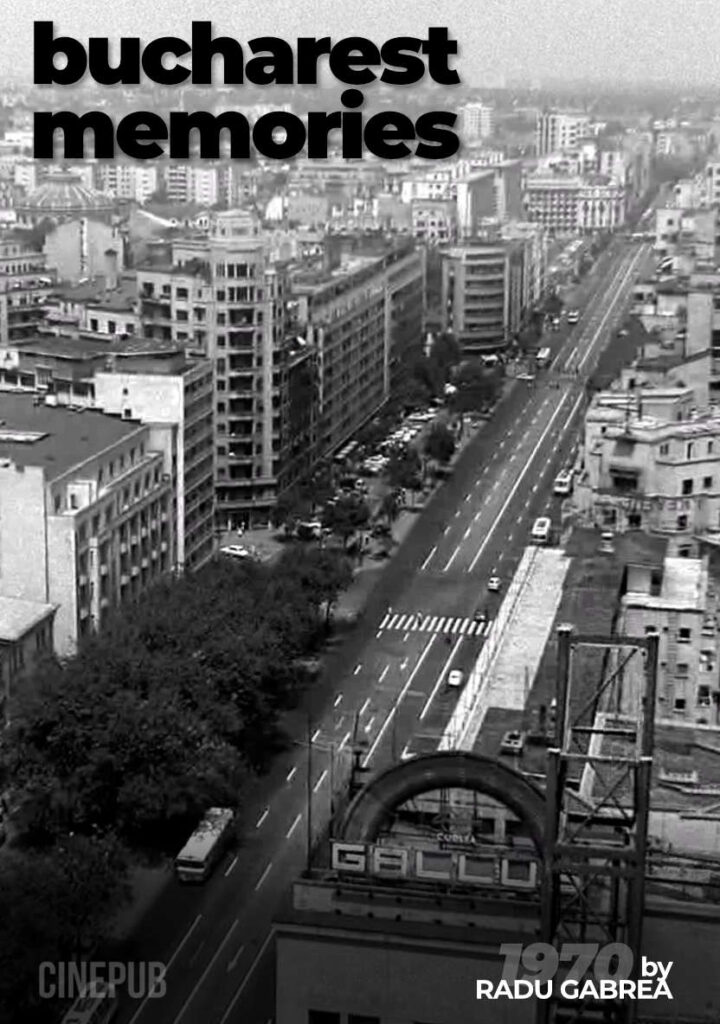
Directed by: Radu Gabrea
Narrators: Valeria Gagealov, Mihai Pălădescu
Commentary: George Macovescu
Producer (combined footage): Dan Eugen
Editing: Margareta Anescu
Sound: Andrei Papp
Project Manager: Constantin Alexandru
Year: 1970
Category: Feature film
Genre: Documentary
Duration: 71 minutes
25,659 – Cinepub viewers
PLOT SUMMARY
Bucharest Memories has everything it takes to delight: it is unique and sensational, full of curiosity and a touch of ridicule, tenderness and irony, striking and moving images.” – Ion Cantacuzino (in Cinema magazine, 1971)
The film is particularly valuable for the documentary images it presents. We discover, for example, scenes with Tudor Arghezi looking at the city panorama, rare shots of Maria Tanase, and recordings of street demonstrations from 1912 (some of which were used for propaganda purposes to illustrate events that took place in the 1920s).
CRITICAL REVIEWS:
- “A montage film is based on two inexorable coordinates: the choice of documentary material and its composition. The choice involves the difficult work of finding and selecting images according to a preconceived plan, but also with a bit of luck. In this regard, Radu Gabrea’s task was not an easy one, as there are very few documents left from what was filmed in Bucharest in the past. He was sometimes forced to supplement with photographs and drawings what luck did not provide him with, from everything his preconceived plan as a screenwriter sought to discover, but these photographs were inspiredly exploited and brought back to life. At other times, he found some highly expressive scenes — the sequence of the family film in the garden is excellently presented, as an idea, grouping, and commentary, or others of profound significance, such as Maria Tănase’s sensational song, a stirring scene that would lend itself to a painful exegesis of the artist’s condition in that era.” – Eva Sîrbu, “Cinema” magazine no. 1, January 1971 (aarc.ro)
- “Bucharest Memories is an attempt at a “biography” of our capital city, searching beyond the official pages of news journals, beyond picturesque scenes sometimes borrowed from fiction films, beyond immediate, contingent communication, for a soul, a “way of being”, if not a ‘style’. This search can be guessed from the initial intention of Arghezi’s “preface” and then among the sequences and especially among the lines of George Macovescu’s wise commentary, with a rigorous drawing that avoids image-word pleonasms, with a fair balance between accurate information, critical or even ironic emphasis, and a restrained lyrical wave. “ – Florian Potra, vol. “A Voice from Off” (aarc.ro)
- “Ion Cantacuzino is too attentive and experienced a connoisseur and observer of the cinematographic phenomenon to have missed from these Bucharest Memories any inaccuracy of information, any fluctuation in the dynamics of the film. The chronicle itself appears as a “montage chronicle”, meticulous and accurate. But the film by the director of Too Little for Such a Big War has, when we abandon a virtual ruler of calculation, a lot of charm. A charm born of the poetry of images of yesteryear, but also of the intelligence with which the director has linked the visual arguments, of the irony present in their subtext. This montage film was an excellent training ground for Radu Gabrea.” – Adina Darian, Cinema magazine, January 1, 1971 (aarc.ro)
- “Two additions. The film is made (and this can be felt in every frame) with a youthful pleasure in working, in rediscovering the city of yesteryear at the editing table, from old photographs and stills. Then Gabrea knew how to look at the old images with understanding, but without exaggerated melancholy. A note of indulgent irony floats over those passages that would otherwise have seemed obsolete to us.” – Al. Racoviceanu, “Cinema” magazine, January 1, 1971 (aarc.ro)
- “I agree especially with two of Ion Cantacuzino’s remarks. First: that this genre and this theme of Memories were ‘a difficult task’ for a young director. Second: that it is difficult to intuit the ‘guiding idea’ of this montage of photographs, with a few carefully chosen and used film frames. I also believe that Valeria Gagialov and Mihai Pălădescu betray and emphasize, through their interpretation of the text, an excess of complicit coldness with mockery.” – Valerian Sava, “Cinema” magazine, January 1, 1971 (aarc.ro)
- “Radu Gabrea’s film, which I saw the day after its premiere, exhausted me terribly: I stood the whole time. There was no free seat for me to sit down. Speaking of this film, I think that we, today, with today’s events, will also be, more or less, other memories in the national film library for future generations. Let us therefore strive to make the memories of the present era as beautiful as possible.” – Jean Georgescu, “Cinema” magazine, January 1, 1971 (aarc.ro)
- “Despite the poverty of images recorded on film, the movie is moving in many of its sequences.” – Gheorghe Vitanidis, “Cinema” magazine, January 1, 1971 (aarc.ro)
TRIVIA:
- The film traces the evolution of Bucharest in archival footage from the early days of cinema (around 1900) to March 6, 1945, in order to capture the city’s enduring character.
- Gabrea watched approximately 200 titles and over 60,000 meters of film from the National Film Archive to find the right images.
- Although initially tempted to use only newsreels, Gabrea also included a lot of material from old feature films, considering them expressions of how directors “saw” those eras.
- The following contributed to the making of the film: the National Film Archive, the Bucharest History Museum, the Institute of Historical and Social-Political Sciences, the Museum of Romanian Literature, and the Romanian Radio and Television Discotheque.
- The film was seen by 847,495 viewers in Romanian cinemas, according to data compiled by the National Center for Cinematography on the number of viewers of Romanian films from the date of release until December 31, 2014.
- Director and screenwriter Radu Bartolomeu Gabrea was born on June 20, 1937, in Bucharest. He attended the “Spiru Haret” High School in Bucharest. He then graduated from the Bucharest Institute of Construction (1960) and the Institute of Theater and Cinematographic Art (IATC) – Film Directing Department (1968). In 2004, he published the book Werner Herzog şi mistica renană (Werner Herzog and Rhenish Mysticism) in Romania (UCIN ex-aequo award), which was the subject of his doctoral thesis in social communications, defended at the University of Louvain-la-Neuve (Belgium).
- According to aarc.ro, an online magazine published by the Romanian Filmmakers’ Union, in 1956, Radu Gabrea, then a second-year student at the Institute of Construction, had his first run-in with the communist regime when he was arrested for wanting to participate, along with other students, in a demonstration of solidarity with the Hungarian Revolution. “After nine months in prison, he was released and then readmitted to the Faculty of Construction, which he graduated from, becoming a civil and industrial engineer,” the website states.
- Later, he enrolled at the Institute of Theater and Cinematographic Art in Bucharest. His debut feature film, Too Little for Such a Big War (1969), based on a screenplay by D.R. Popescu, won an award at the Locarno Film Festival in 1970 and was selected for the Quinzaine des réalisateurs at Cannes, also in 1970.
LINES:
• “Bucharest also has its memories, preserved in people’s minds, written down on paper, captured on film.”
• “The beginning of the century in Bucharest. People were skating in Cișmigiu Park, or rather, sliding on the ice.”
• “Sleds passed by Calea Victoriei. In the history of the city, the Oteteleșanu terrace became an institution. The academy, the terrace, the theater, and the literary café.”
• “Parisian fashion ruled the Bucharest elite. Maxi dresses were in style, and waists were high.”
• “Officials crowded into the Roman Arenas, or not so much. Come on, you fools, to the jubilee, said Caragiale.”
• “Cinema, the wonder of the century, had invaded Bucharest.”
• “Vlaicu’s airplane was a great achievement in aviation at the time.”
• “Blériot, the conqueror of the English Channel, arrived in Bucharest.”
• “1910. At the Dacia Hall, workers were protesting, taking to the streets, and Bucharest looked different then.”
• “People danced the Charleston on Floreasca beach.”
• “Radio was in its infancy.”
• “Fănică Luca was young. Light music. Silly Vasiliu.”
• “Cafes set up tables on the sidewalks, the beer was cold, but not always, the coffee was good, but not always, the waiter was friendly, but not always.”
• “From Capșa to Piața Palatului, especially the sidewalk, is a veritable traveling exhibition of everything you could want.”
• “In May, the Moșilor Fair opened in Eliad’s field.”
• “When he wasn’t at Cărăbuș, Tănase was shooting movies.”
• “Grivița left deep marks on the consciousness of the Romanian people.”
ARTICLES:
- Review: Bucharest Memories, by Ion Cantacuzino – aarc.ro
- 100 years of Bucharest walks in 21 films – urbaneye.ro
- Review: The City in the Film Archive, by Eva Sîrbu – aarc.ro
- Review: Bucharest Memories, by Florian Potra – aarc.ro
- Joint article: Bucharest Memories – Pros and Cons? – aarc.ro
- Review: A Moral Obligation, by Radu Gabrea – aarc.ro
- Review: “Advertising in Action” by Radu Gabrea – aarc.ro
- Bucharest in the Memories of Film – observatorcultural.ro
- Documentary: 85 Years Since the Birth of Director Radu Gabrea – agerpres.ro


